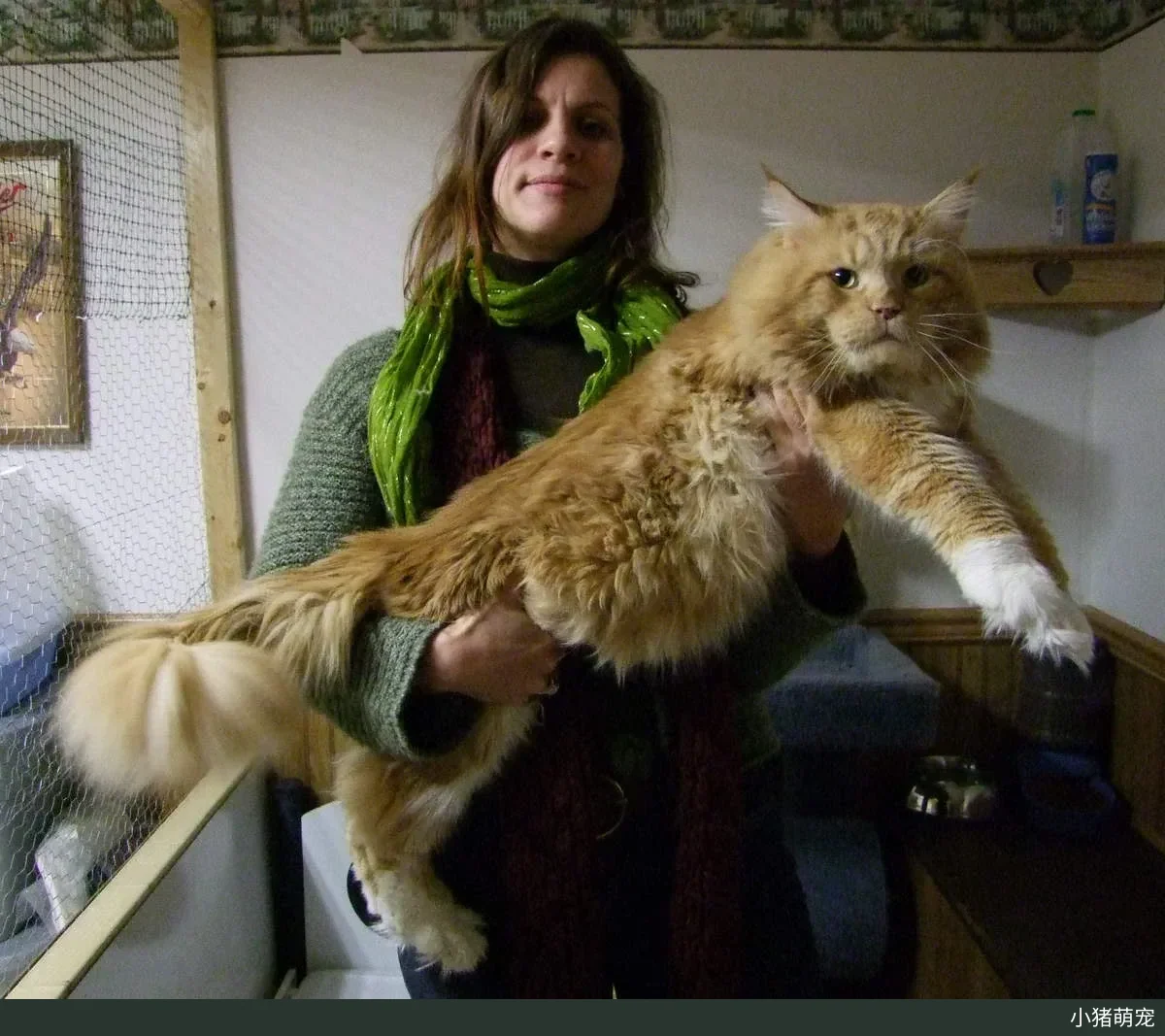
A woman holding a red tabby-and-white Maine Coon male, showing the breed’s size at a glance. Photo: Alexandra Thiry; source: Wikimedia Commons; license: CC BY-SA 3.0.
The Maine Coon is native to the northeastern United States, usually regarded as Maine’s indigenous breed and among the largest pedigreed cats. Its dense long coat, tufted ears and large feet, and bushy long tail all fit a past as a “working cat” through New England winters. Drawing on CFA and TICA materials and veterinary literature, this article covers origins, appearance, temperament and care, plus two health issues to watch.
Maine origins and documented history
The “Coon” in the English name comes from a widely told story: brown tabby Maine Coons have bushy, ringed tails that look like a raccoon’s, so some guessed they were cat–raccoon hybrids. CFA and TICA both state clearly that such a cross is biologically impossible. Other legends—Marie Antoinette’s cats sent to Maine, or a Captain Coon with a ship full of longhairs—are likewise only stories.
A more plausible account roots them in New England. CFA holds that ancestors were shorthaired ship cats that came ashore with early settlers; TICA says most breeders believe local shorthair domestics crossed with longhairs from overseas—possibly Angora types brought by New England sailors—though the exact path remains unsettled. Through harsh New England winters these cats became self-reliant working cats, and the Maine Coon is usually treated as Maine’s native breed.
Written history begins in the mid-nineteenth century. CFA traces documented history to the 1850s; TICA’s earliest citation is an 1861 mention of a black-and-white cat, “Captain Jenks of the Horse Marines.” Early Maine Coons were regulars at Boston and New York shows: in 1895 a brown tabby Maine Coon was named Best Cat—CFA calls that America’s first cat show; TICA records it as that year’s Madison Square Garden show. The cat’s silver collar and medal are displayed at the Feline Historical Museum at CFA headquarters in Alliance, Ohio. The associations disagree on the record: CFA writes Cosey and uses “he”; TICA writes Cosie and calls the cat a female.
In the early twentieth century other longhair breeds rose and Maine Coons faded from the show hall. In the 1960s–70s breeders pushed for formal recognition again; Maine Coons gained CFA Championship status in 1976 and for years ranked among CFA’s top ten by registration. In 1985 the Maine Coon became Maine’s state cat.
Large size and cold-weather build
The most obvious trait is size. CFA calls it the largest of all pedigreed cats; TICA says “one of the largest.” CFA writes that adult males at or over 20 lb (about 9 kg) are not uncommon, with females usually smaller; TICA’s breed page lists healthy weights of about 18–22 lb (about 8–10 kg) for males and 12–15 lb (about 5.4–6.8 kg) for females, yet elsewhere on the same page averages of 13–18 lb for males and 9–13 lb for females. Sources diverge widely; treat the numbers as rough guides only.
They also grow slowly. CFA says Maine Coons may take three years to finish growing; TICA says full maturity is usually around four, with adult size taking three to five years. A one- or two-year-old Maine Coon is often still developing.
Coat and body details show cold adaptation throughout. Per CFA’s standard, the coat is heavy and shaggy—shorter on the shoulders, longer on the belly and hind legs (“pants”), preferably with a ruff; ears are large with clear tufts; paws are large and round with tufts; the tail is long, broad at the base, and flowing. CFA likens the big, hairy feet to being “made for walking on snow”; TICA adds that adult coats are double, heavy, and water-resistant.
Polydactyly is also a historical trait. TICA notes early Maine Coons were often polydactyl, the extra toes thought to act like natural snowshoes; today TICA registers polydactyl individuals separately as Maine Coon Polydactyl, while CFA’s standard requires five toes in front and four behind. On color, both associations accept most colors and patterns; brown tabby is most common. Neither accepts pointed colors; CFA also excludes chocolate and lavender.
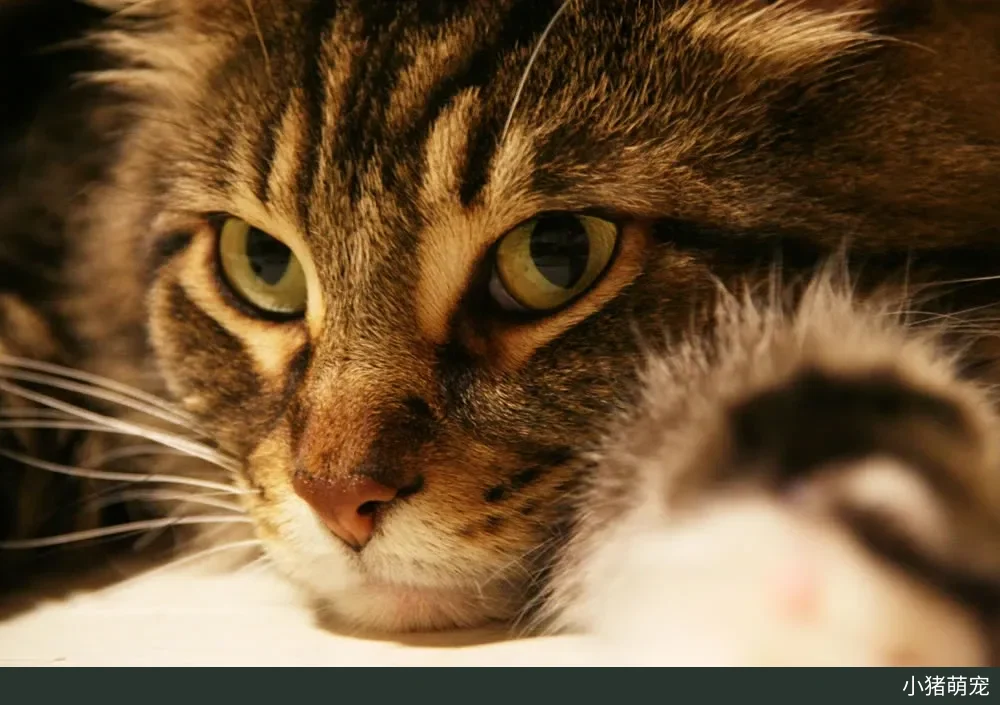
A brown tabby Maine Coon resting; the foreground shows its fluffy large paw. Photo: fox_kiyo; source: Wikimedia Commons (originally on Flickr); license: CC BY-SA 2.0.
Temperament and daily care
CFA calls Maine Coons the “gentle giants” of the cat world—friendly, loyal, and smart, happy to interact with every household member and often moving from one lap to another rather than bonding to only one person. TICA describes them as gentle and easygoing, following owners from room to room and wanting to “help” with everything, yet not necessarily lap cats or constant attention-seekers. Many Maine Coons like water, watching dripping taps or even trying to join you in the bathroom.
Their voices are distinctive too: chirps and trills are common; loud meows less so. TICA notes many play fetch, and some learn leash walks; they prefer chasing floor toys over high jumping. They generally get along with children, dogs, and other cats, though CFA warns their size can startle kids and other pets at first.
Care centers on brushing and weight control. CFA cites breeders who recommend two to three sessions a week of five to ten minutes to cut shedding, hairballs, and mats; TICA notes coat texture varies by individual and line—some cottony coats need daily brushing—and habits are best started as kittens. TICA also suggests weekly nail trims for kittens and every two to three weeks for adults, plus regular tooth brushing. Neutered Maine Coons gain weight more easily; watch food quality and portions with your veterinarian.
Heart disease and hip problems
Hypertrophic cardiomyopathy (HCM) is the most common heart disease in cats. Cornell’s Feline Health Center explains that it thickens the left ventricular wall, reduces pumping efficiency, and can lead to congestive heart failure or clots; Maine Coons are among the breeds more often affected. In 2005 Meurs and colleagues found the MYBPC3 A31P mutation in affected Maine Coons. Per UC Davis Veterinary Genetics Laboratory (VGL) summaries, one mutant copy raises HCM risk about 1.8-fold versus clear cats, and two copies about 18-fold, with the latter possibly causing sudden death by age four or earlier.
A negative genetic test does not mean a clear heart. UC Davis VGL notes A31P is not the only cause of Maine Coon HCM; cats without the mutation can still become ill. Cornell also stresses that carriers do not all develop disease, and results need veterinary interpretation. HCM is diagnosed by echocardiography after ruling out hypertension, hyperthyroidism, and other causes of wall thickening. TICA advises responsible breeders to do both genetic testing and regular echocardiograms with a veterinary cardiologist.
What to watch at home? Cornell notes many HCM cats look normal; with heart failure there may be rapid or labored breathing, open-mouth breathing, or lethargy; clots most often lodge in the hind legs, causing sudden severe pain and sometimes paralysis. Seek care promptly for these signs.
Hip dysplasia is another issue to know. A 2018 Journal of Feline Medicine and Surgery study of Orthopedic Foundation for Animals (OFA) hip scores for 2,548 Maine Coons through April 2015 found 24.9% dysplastic—males 27.3%, females 23.3%—with 56% bilateral and the youngest case only four months old. The authors caution that OFA registry data may not generalize to all Maine Coons. TICA also notes that as large cats they may be more prone to joint problems; many breeders radiograph hips and screen for patellar luxation, and DNA tests for spinal muscular atrophy (SMA) and pyruvate kinase deficiency are increasingly common.
If you plan to bring home a Maine Coon, ask the breeder about parental HCM genetic tests, echocardiogram reports, and hip radiographs, and tell your veterinarian the breed background so follow-up screening can be planned.
References
-
The Cat Fanciers' Association (CFA). Maine Coon Cat (includes breed standard). Accessed 2026-10-21.
-
The International Cat Association (TICA). Maine Coon. Accessed 2026-10-21.
-
UC Davis Veterinary Genetics Laboratory. Hypertrophic Cardiomyopathy (HCM) in Maine Coons. Accessed 2026-10-21.
-
Cornell Feline Health Center. Hypertrophic Cardiomyopathy. Updated May 2025.
-
Meurs KM, et al. A cardiac myosin binding protein C mutation in the Maine Coon cat with familial hypertrophic cardiomyopathy. Human Molecular Genetics, 2005, 14(23): 3587–3593.
-
Loder RT, Todhunter RJ. Demographics of hip dysplasia in the Maine Coon cat. Journal of Feline Medicine and Surgery, 2018, 20(4): 302–307.