Sheep fill a narrow race from fence to fence. A black-and-tan Australian Kelpie steps onto their backs and makes its way towards the front. The photographer caught the dog at work in a sheepdog competition. To get the flock moving, it needs to reach the lead sheep. Calling the Kelpie energetic misses something you can see in that photograph. The dog has the strength to cross those backs, and it has a reason to get to the other end. That sense of purpose deserves a place in its life at home, too. [1][2]

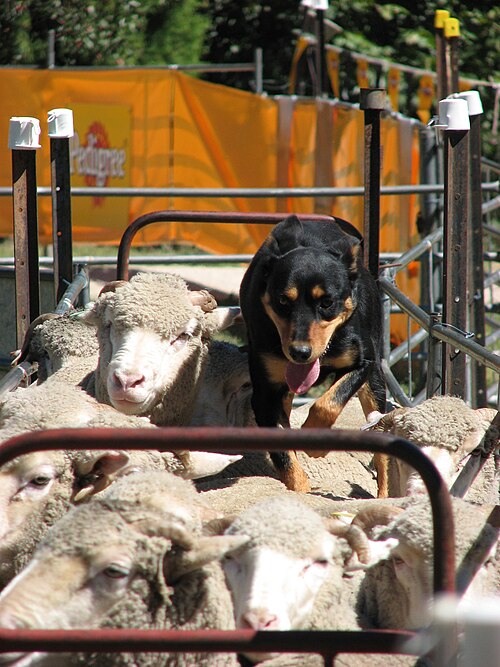
图:A Kelpie backing sheep. Peter Shanks, Wikimedia Commons[2]
The Kelpie learnt its trade in Australia’s sheep country. As sheep stations expanded in New South Wales and Victoria, a single flock could spread out to graze over a vast area. Shepherds needed dogs that could cover dusty, rough ground to gather the sheep, then work in the tight confines of a yard to move them on. Collie-type sheepdogs from Scotland were among the Kelpie’s ancestors. Breeders in Australia selected dogs to suit the climate and the work. The American Kennel Club (AKC) has recorded the Australian Kelpie in its Foundation Stock Service since July 10, 2017. [1]
The Kelpie in profile
The dog standing in the snow gives a clear side view of the Kelpie’s proportions. From the forechest to the point of the buttocks, the body is slightly longer than the dog is tall at the shoulder. The breed standard gives that ratio as about ten to nine. Look for a deep chest, a strong loin and cleanly outlined legs. At rest, the tail hangs down along the slope of the rump. This is a medium-sized dog, about 17 to 20 inches (43 to 51 centimetres) at the shoulder, according to the AKC. To change direction with a flock, a Kelpie needs both muscle and freedom of movement. Its overall outline tells you more about that combination than leg length or weight alone. [1][3]

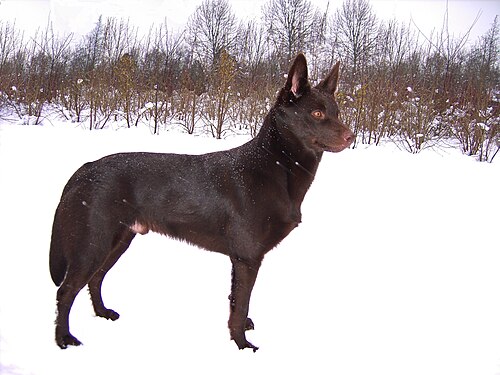
图:Bashyr in profile. Daphne Geerlings, Wikimedia Commons[3]
From the front, look at the space between the ears, the muzzle tapering towards the nose and the well-defined corners of the almond-shaped eyes. The standard describes upright ears with fine tips, inclined slightly outwards. In the portrait, Diesel has one ear up and the tip of the other folded forwards. Two pale marks stand out above the eyes. Bashyr, the dog in the snow, is dark brown all over. When learning to recognise a Kelpie, it helps to look at the shape of the head, the proportions of the body and the close-lying coat together. Colour alone gives you little to go on. [1][3][4]

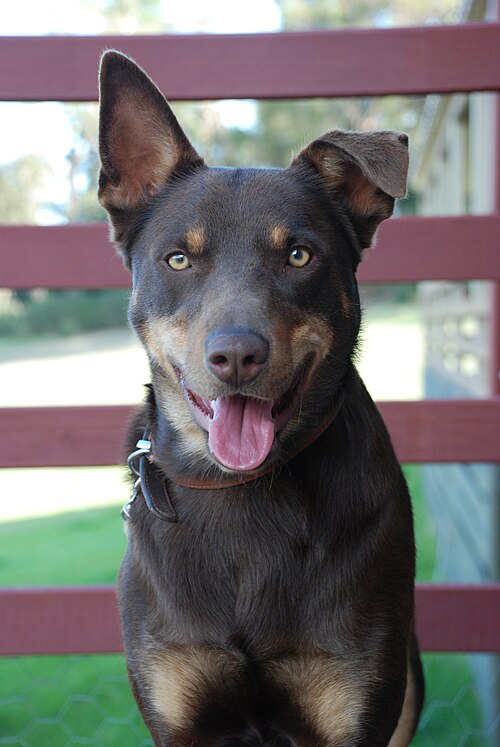
图:A portrait of Diesel. davepaku, Wikimedia Commons[4]
Give your Kelpie a cue to follow on a walk
Make room for two things in a Kelpie’s day. One is a stretch of outdoor exercise with space to move. The other is a task that asks the dog to pay attention to you. The AKC suggests jogging or other sustained exercise alongside daily obedience practice. It also mentions dog sports such as agility and rally. In both sports, the dog watches its handler for information about where to go, when to turn and when to stop. If your family enjoys running, you already have a good starting point. Would you also enjoy teaching a dog a new cue? [1]
An ordinary walk has room for a small job. Choose a quiet stretch where you and your dog can turn comfortably on lead. Walk together for a few paces. As you reach a turn, give a familiar cue to walk beside you. Reward the dog as soon as it turns to follow, then let it go back to exploring. Once the route is familiar, add a stop on the way home. Ask the dog to wait and give it a cue to set off again. The walk now includes a few moments when your dog has a decision to make. How readily it responds can help you judge the difficulty of the exercise. There is no single mileage target that fits every Kelpie. [1]
If you have children or other pets, an especially worthwhile cue to teach early is “come back to me”. A Kelpie may try to gather running children, other dogs or household pets much as it would gather sheep. Have an adult practise recall somewhere quiet, so the dog can come straight back for a reward when it hears the cue. When the children play chase, an adult can stay with the dog some distance away. Call while the dog can still turn its attention back to you, then take it for a short walk. If it is already staring at a runner and struggling to respond, lead it away and give the children space to play. [1]
To judge whether the arrangement will work over the years, picture your busiest weekday. Who can exercise the dog in the morning? Who will take charge of it when the children go out to play that evening? Is there an open space nearby that you can use regularly? The AKC considers apartment life generally a poor fit for the Kelpie’s need for space. Families with a garden can run through the same questions. Opening the back door gives the dog room to move. Teaching it to follow, wait and finish a game takes someone’s time. A Kelpie can also settle down with its family after exercise, so leave room for that quiet stretch together. [1]
Brush the Kelpie’s double coat each week
In the photographs, the coat lies close to the body. Part the outer hairs and underneath is a short, dense undercoat. The coarser outer coat lies straight and helps shed rain. The hair is short on the head and the fronts of the legs, thicker around the neck and longer on the backs of the legs and the tail. The AKC recommends a weekly brush or comb to remove loose hair and an occasional bath. A convenient time to brush is after an outing, once the dog has settled. Work over the back and sides, then give the thicker hair around the neck, the backs of the legs and the tail a turn. [1]
Daily practice brings one easy-to-miss detail at mealtimes. Training rewards count towards the dog’s food intake. If several people take turns with the dog, set aside a small portion of food in the morning and have everyone draw rewards from it. By supper, you can see how much the dog has already eaten on walks and during recall practice. Choose food suited to its stage of life, keep track of changes in weight and make sure fresh water is always within reach. [1]
Before bringing a puppy home, set aside time to talk with the breeder about health. The AKC notes that breeders can use genetic testing to guide mating decisions and reduce the chance of inherited disease in puppies. If the breeder says both parents are healthy, ask which tests each parent had and how the results informed this particular pairing. Keep copies of the reports with the puppy’s health records. At a future appointment, your vet will then have the family history that was available when you chose the dog. That part of caring for a Kelpie can begin before it ever sets foot in your home. [1]
References
-
[1] American Kennel Club. Australian Kelpie.
-
[2] Peter Shanks. Backing sheep at sheepdog competition. Wikimedia Commons.
-
[3] Daphne Geerlings. Australian Kelpie- Yirr-ma Bashyr of the Two Chestnuts. Wikimedia Commons.
-
[4] davepaku. Australian Kelpie portrait. Wikimedia Commons.