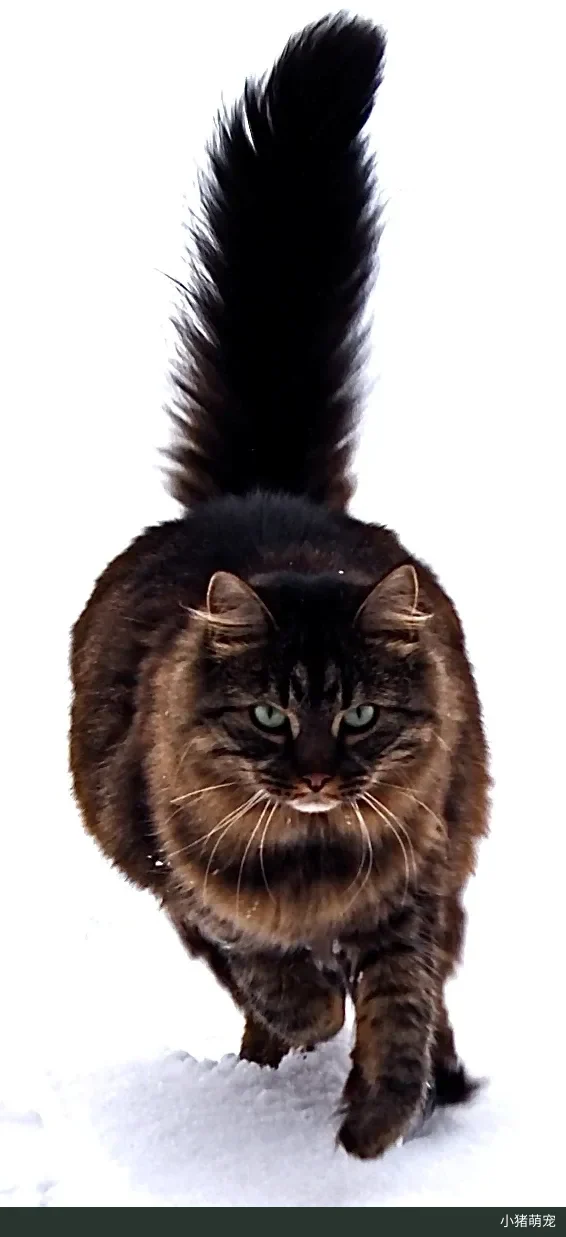
A dark tabby Maine Coon walks toward the camera through snow with its bushy long tail held high. Photo: Tomitheos (derivative work: David Shankbone); source: Wikimedia Commons; license: CC BY-SA 3.0.

The Maine Coon is a longhaired breed that originated in New England in the United States. The Cat Fanciers’ Association (CFA) calls it the largest of the pedigree cats and nicknames it the “gentle giant.” It has a sturdy build, a thick water-resistant coat, and a long, bushy tail; temperament is friendly and people-oriented without being clingy. Breed associations and veterinary sources note hypertrophic cardiomyopathy, hip dysplasia, and spinal muscular atrophy as health issues to watch when choosing and living with one.
Origins and breed history
The Maine Coon is treated as the only longhaired pedigree cat native to the United States. The International Cat Association (TICA) calls it one of North America’s oldest natural breeds, and in 1985 it became Maine’s official state cat. The “Coon” in the name comes from a widely told story: that cats crossed with raccoons, producing the bushy ringed tail and raccoon-like brown tabby coloring. Both CFA and TICA note that is biologically impossible. Other tales—such as Marie Antoinette’s cats being sent to Maine—are likewise legend only. CFA places the breed’s roots in New England, linked to shorthaired cats on early immigrant ships; TICA’s mainstream account is that local shorthaired house cats crossed with overseas longhaired cats brought by sailors, though the exact origin remains unsettled.
CFA says the Maine Coon’s documented history reaches the 1850s; TICA records that feline literature in 1861 already mentioned a black-and-white Maine Coon named “Captain Jenks of the Horse Marines.” At the first U.S. cat show in 1895, a brown tabby Maine Coon was judged “best cat”; the two associations differ slightly on the record—CFA writes Cosey (a male), TICA writes Cosie (a female). Early in the twentieth century other longhaired breeds rose in popularity and Maine Coons briefly left the show circuit; breeders pushed for renewed recognition in the 1960s–1970s, and in 1976 the breed gained CFA Championship status, remaining for many years among CFA’s top ten by registrations.
Looks and temperament
Per CFA’s breed standard, the Maine Coon is muscular with a broad chest, a long body, and an overall balanced rectangular outline; the standard also stresses that no part should be over-exaggerated—“type should not be sacrificed for size.” The head is slightly rectangular, the muzzle square, the ears large and often clearly tufted, and the eyes large and expressive. The coat is heavy, fluffy, and smooth: shorter on the shoulders, longer as “britches” on the belly and hind legs, often with a chest ruff; the tail is long and bushy, and the large paws carry tufts of hair thought to help walking in snow. Almost all traditional colors and patterns appear; brown tabby is most common. CFA’s standard does not accept chocolate, lilac, or pointed (Himalayan) patterns that signal outcrossing. Early Maine Coons were often polydactyl; TICA lists polydactyl individuals separately as “Maine Coon Polydactyl.”
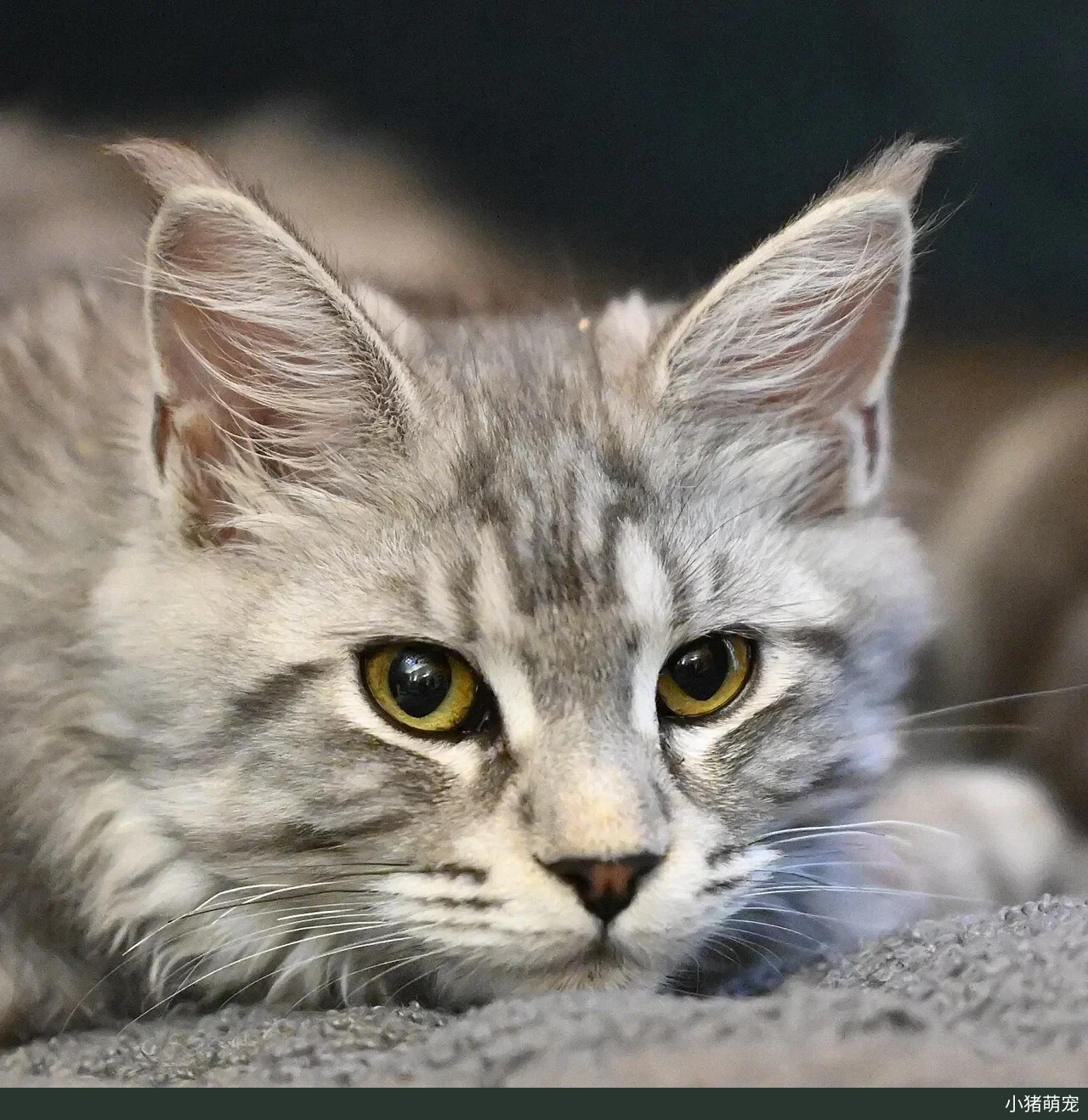
Head close-up of a black silver classic-tabby female Maine Coon, with tufts visible at the ear tips. Photo: Azurfrog; source: Wikimedia Commons; license: CC BY-SA 4.0.

Maine Coons mature slowly: CFA says full adult size can take up to three years; TICA’s page says three to five years (elsewhere that they are usually fully mature at four). Weight figures also vary: CFA notes that adult males at or above 20 pounds (about 9 kg) are not uncommon, with females usually smaller; TICA’s same page gives two ranges—males 13–18 or 18–22 pounds (about 5.9–10 kg), females 9–13 or 12–15 pounds (about 4.1–6.8 kg). TICA lists expected lifespan as over 12.5 years. These numbers only sketch the breed’s rough range; whether any one cat is overweight or underweight should be judged by a veterinarian from body condition.
On temperament, both associations describe Maine Coons as friendly, gentle, and people-oriented without being clingy: they like to follow family members from room to room, come over to “help,” and wait outside closed doors, but most are not classic lap cats. They usually get along with children, dogs, and other cats, though CFA notes that children and other pets may at first be startled by the size. Maine Coons rarely meow loudly; they more often chirp and trill softly. Many enjoy water play and retrieve games, and prefer chasing things on the ground over climbing high. These descriptions reflect breed-level tendencies; individual cats still differ.
Common health issues
The following comes from breed-association and veterinary sources at the population level, to outline breed risk—not to diagnose any particular cat. If a cat shows abnormalities, seek veterinary care promptly for examination and diagnosis.
Hypertrophic cardiomyopathy (HCM) is the most common heart disease in cats. Cornell University’s Feline Health Center explains that HCM thickens the left ventricular wall, reduces pumping efficiency, and can lead to congestive heart failure or intracardiac thrombi; clots most often block blood flow to the hind limbs, causing sudden hind-limb pain or paralysis, and a minority of cases die suddenly. Many affected cats look normal outwardly; some show rapid or labored breathing, open-mouth breathing, and lethargy. Diagnosis relies on echocardiography and must rule out hypertension, hyperthyroidism, and other conditions that also thicken the myocardium. HCM cannot currently be cured, but appropriate treatment can control signs and improve quality of life. Maine Coons appear on Cornell’s list of predisposed breeds.
UC Davis Veterinary Genetics Laboratory (UC Davis VGL), citing Meurs et al. 2005, notes that the MYBPC3 A31P mutation in Maine Coons is linked to higher HCM risk: cats with one copy have roughly 1.8 times the likelihood of HCM versus cats without the mutation; cats with two copies about 18 times, and the latter may develop moderate-to-severe heart disease and sudden death by age 4 or earlier. After summarizing published work, the laboratory estimates that about two-thirds of Maine Coons worldwide do not carry this mutation. Maine Coons without the mutation can still get HCM—A31P is not the only cause. Cornell also notes that not every carrier develops disease, and genetic results need veterinary interpretation. For that reason both TICA and CFA say responsible breeders combine DNA testing with periodic echocardiography; TICA further requires that echo results be evaluated by a veterinary cardiologist.
As a large cat, the Maine Coon can also have joint problems. TICA and CFA note that many breeders screen hips with radiographs; TICA also mentions patellar luxation screening (radiographs or physical exam). Spinal muscular atrophy (SMA) is a known hereditary disease in Maine Coons: UC Davis VGL explains it is caused by a large deletion on chromosome 1, inherited as an autosomal recessive—only cats that receive one pathogenic copy from each parent are affected. Affected kittens show an unsteady gait and hind-limb muscle wasting around 3–4 months of age; the disease is not painful and not fatal, and affected cats can live comfortably indoors. When two carriers are mated, about 25% of kittens are expected to be affected, so DNA testing helps breeders avoid such pairings. TICA also notes that DNA screening for pyruvate kinase deficiency is increasingly common among breeders.
Choosing and caring for a Maine Coon
- Ask for screening records when choosing a cat: Ask the breeder for the parents’ HCM DNA and echocardiogram records, hip radiographs, and SMA test results; a single negative DNA test does not mean a cat will never develop HCM.
- Groom regularly: CFA suggests brushing two to three times a week for 5–10 minutes to reduce shedding and hairballs and prevent mats. TICA notes coat texture varies by individual—cottony coats may need daily brushing, while silky coats are easier; either way, start the habit as a kitten. Most Maine Coons do not need regular baths.
- Nails and teeth: TICA suggests weekly nail trims for kittens and every 2–3 weeks for adults, plus regular tooth brushing as with other cats; ask a veterinarian for technique.
- Diet and weight: TICA suggests a high-quality, balanced diet higher in protein and lower in carbohydrate; Maine Coons gain weight more easily after neutering, so watch both food quality and portion size.
- Water: Provide fresh, clean water daily. TICA relays feline behaviorists’ advice: keep the water bowl at least about 1 meter (3 feet) from food, or use a filtered fountain.
- Activity and company: Most Maine Coons stay playful for life; interactive toys, retrieve games, and even leash walks can provide exercise. They need a moderate amount of interaction and will “join in” when people are home.
- Watch for heart-related signs: Rapid or labored breathing, open-mouth breathing, or sudden hind-limb pain or weakness warrant prompt veterinary care.
References
-
The Cat Fanciers' Association (CFA). Maine Coon Cat (includes breed standard; page undated, accessed 2026-10-24)
-
The International Cat Association (TICA). Maine Coon (page undated, accessed 2026-10-24)
-
Cornell Feline Health Center, Cornell University College of Veterinary Medicine. Hypertrophic Cardiomyopathy (updated May 2025, accessed 2026-10-24)
-
Veterinary Genetics Laboratory, UC Davis. Hypertrophic Cardiomyopathy (HCM) in Maine Coons (page undated, accessed 2026-10-24)
-
Veterinary Genetics Laboratory, UC Davis. Spinal Muscular Atrophy (SMA) in Maine Coon Cats (page undated, accessed 2026-10-24)
-
小猪萌宠 · Welcome to my pet planet