On the farm, a German Pinscher needed a sharp eye and a quick turn of speed to catch rats. The dog had to spot a small animal as it moved, then get there before it disappeared. Guarding the property also called for a dog that noticed changes in its surroundings. Both abilities matter on a walk today. The field ahead might have plenty of room to run, but if a rabbit bolts from the grass, is this a good place to unclip the leash? [1][2]
Look at the dog standing sideways on the grass. The chest reaches nearly to the elbows. Farther back, the back is short, the loin is strong, and the belly line rises gradually. The body looks almost as long as it is tall, with room for the legs to stand comfortably underneath. The American Kennel Club (AKC) gives a height of 17–20 inches (about 43–51 cm) at the shoulder and a weight of 25–45 pounds (about 11–20 kg). That puts the German Pinscher between the Miniature Pinscher and the Doberman in size. Whoever walks this compact, muscular working dog needs to be able to keep a steady hold on the leash if the dog suddenly changes direction. [1][3]
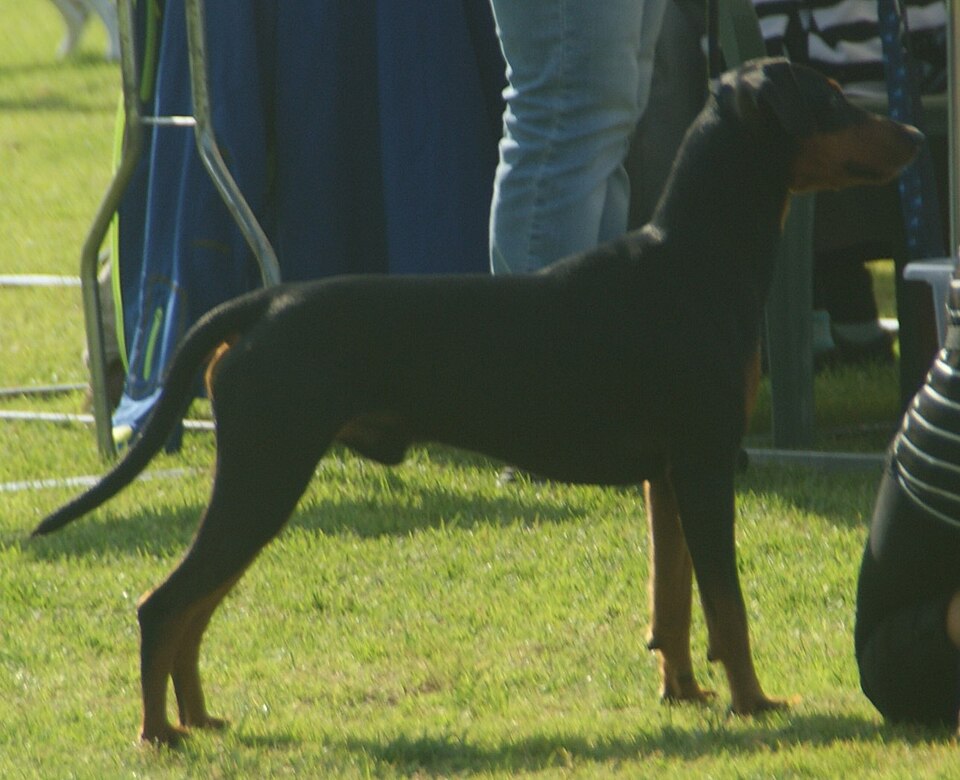
The German Pinscher has a nearly square outline. Canarian, Wikimedia Commons[4]

To see the shape of the head, follow the bridge of the nose from the eyes to the tip. The long head tapers gradually, keeping enough width at the muzzle to give it the shape of a blunt wedge. In the close-up, the red dog looks up at the handler. You can see the oval eyes, the short hair lying flat against the cheeks, and the outline of the muzzle. On the black-and-tan dog, lighter markings pick out the brows and the sides of the muzzle. The shape of the head, the body proportions, and the short, dense coat together tell you more about the breed than ear shape or a single marking can. [1]
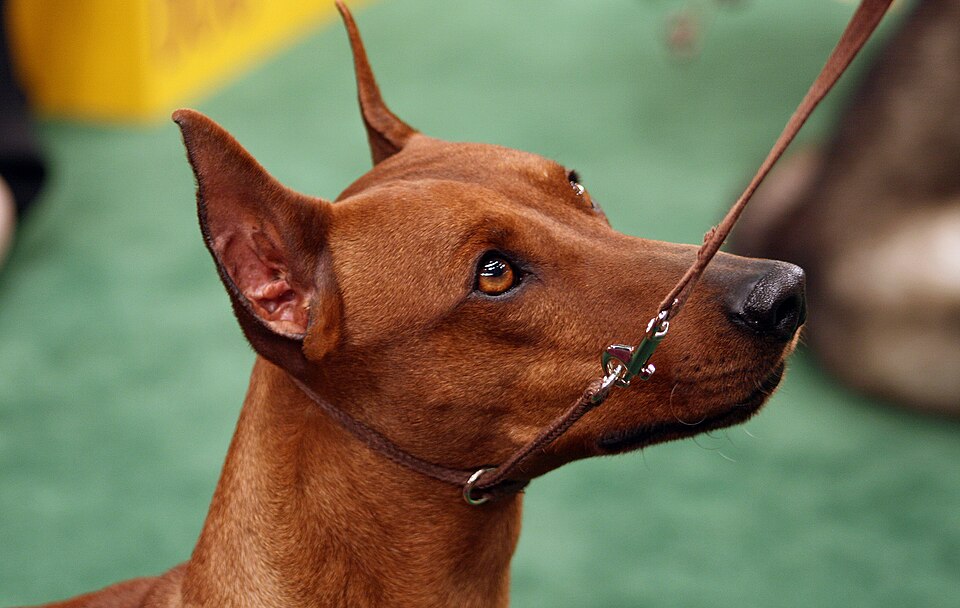
The head tapers to a blunt wedge. Lori Branham, Wikimedia Commons[5]

Walk the fence line first
When choosing a place for exercise, walk around its edge. Lawns, woodland clearings, and trails without a continuous fence are places for leash walks. In an enclosed area, check that the gate latches securely and look for loose earth or gaps along the bottom of the fence before letting the dog run. The German Pinscher Club of America points out that these dogs like to dig and need supervision even in a fenced yard. A yard just steps from the kitchen is convenient, but someone still needs time to go outside and play with the dog. [2][3]
Start with an ordinary workday. Who can take the dog for a morning walk long enough to let it stretch its legs? Who has time in the evening to try a different route and let the dog stop and sniff along the way? German Pinschers need daily exercise and enjoy tasks that give them something to concentrate on. A family that loves weekend hikes still needs to find that time Monday through Friday. If you have no yard, a nearby enclosed exercise area can be part of the plan. Count the time it takes to get there and back. [1][3]
Give the dog something to do with you inside the enclosure. Let it watch you set a familiar toy at the edge of the grass, give a cue to find it, and go along as it searches. Once the dog knows the game, try another hiding place. Now there is something worth finding in the grass, and you are part of the fun. For more structured training, consider tracking, scent work, or agility. Tracking gives the dog a trail to follow with its nose down. Agility asks it to watch the handler for direction while moving at speed. Both put the breed’s alertness to work. [1][3]
Make coming back part of the game
With a dog that keeps an eye out for movement, the challenge is often keeping its interest in what you are doing together. Start practicing recall in a quiet room. While the dog is still paying attention to you, step back a few paces and call it using the same word each time. Give a small reward when it reaches you. Sometimes, let it go straight back to playing. Once that back-and-forth is familiar, try it in the yard with the gate latched. Everyone in the household should use the same cue and reward the dog as soon as it comes. Keep the leash on in open areas where small animals may appear. [1][3]
That rat-catching instinct deserves particular thought in a home with small pets. The German Pinscher Club UK singles out gerbils and rabbits, whose movements may prompt a chase. Before getting a dog, walk through your usual routine. Where would the dog be while you let the rabbit out for exercise, change its bedding, or carry in its food bowl? A door you can close gives each animal its own space during those everyday jobs. If the rabbit usually has the run of the living room and there is no way to divide the space, that alone may decide whether the breed fits your household. [2]
Experience also helps when introducing a puppy to unfamiliar surroundings. On a first outing near pedestrians and traffic, find a quiet spot far enough away for the puppy to watch. Then ask for something it already knows how to do at home. Move a little closer to the bustle once the puppy can still respond to you and walk along beside you. The AKC emphasizes early socialization and obedience training. Someone who has handled working dogs before may find it easier to judge how much to ask. First-time owners can choose a puppy class before bringing the dog home, decide who will attend, and set aside time to practice between classes. [1][3]
Check ears and paws during the weekly brushing
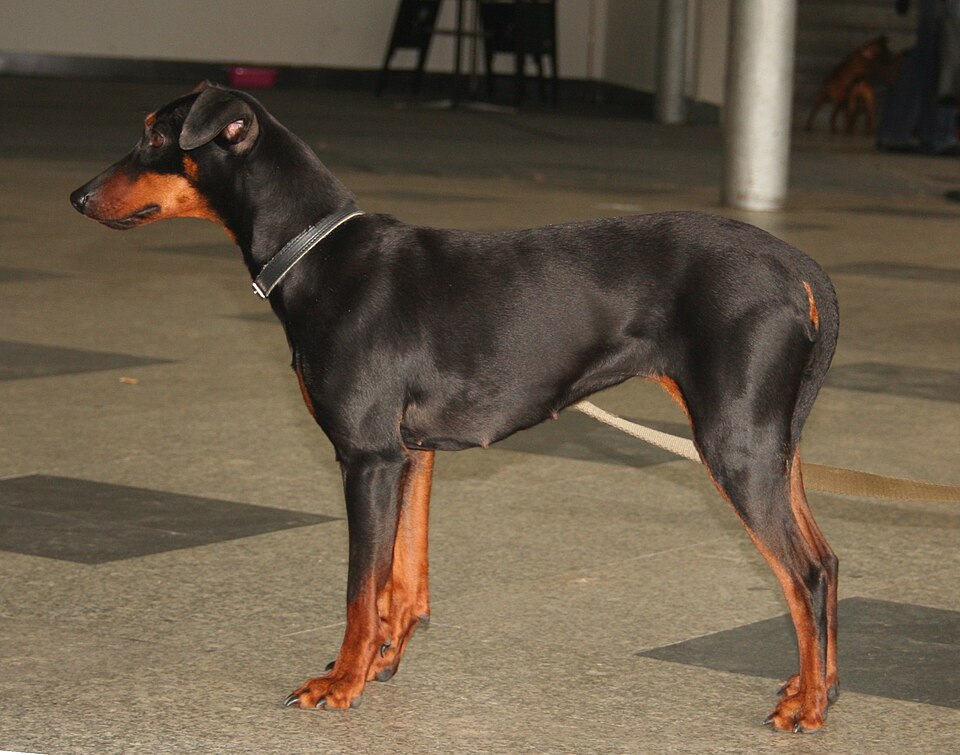
The short coat lies close to the body. Pleple2000, Wikimedia Commons[6]

In the photograph, light catches the shoulder and back, and you can trace the muscles beneath the short hair. This dense, close-fitting coat is straightforward to care for. Brush it once a week and bathe the dog as needed. While brushing, look inside the ears for dirt or excess wax and clean them when needed. Check nail length each month and trim nails that have had too little natural wear. Overlong nails can make it painful for the dog to put a foot down as it walks, turns, or runs. Teeth need their own routine, too. Brush them regularly with toothpaste made for dogs. [1]
Before bringing a puppy home, sit down with the breeder and look at the health records for both parents. The AKC lists a hip evaluation, a cardiac examination, an evaluation by a veterinary ophthalmologist, and a DNA test for type I von Willebrand disease. Ask the breeder to show you each parent’s results and explain what each test looked for. That conversation tells you more about the litter’s family history than a general question about whether the puppies are healthy. Once the puppy is home, bring the records to its first veterinary visit. You can then discuss feeding, weight management, and routine care in light of the puppy’s age, body condition, and activity level. [1][3]
References
-
[1] American Kennel Club. German Pinscher Dog Breed Information.
-
[2] The German Pinscher Club UK. German Pinscher Temperament.
-
[3] German Pinscher Club of America. Congratulations on your new German Pinscher!. 2017.