Two jobs shaped the Border Terrier. In the hills along the border between England and Scotland, shepherds used terriers to drive foxes from their dens. Before a dog could reach a den, it had to cover rough ground alongside hounds and riders. That took legs long enough to keep pace. Once at the entrance, the dog had to squeeze underground, where narrow shoulders and a slim body served it well. Look at a Border Terrier standing side-on and you can see both qualities at once: the clearance beneath the belly and the four sturdy legs that carry its lightly built frame. [1]
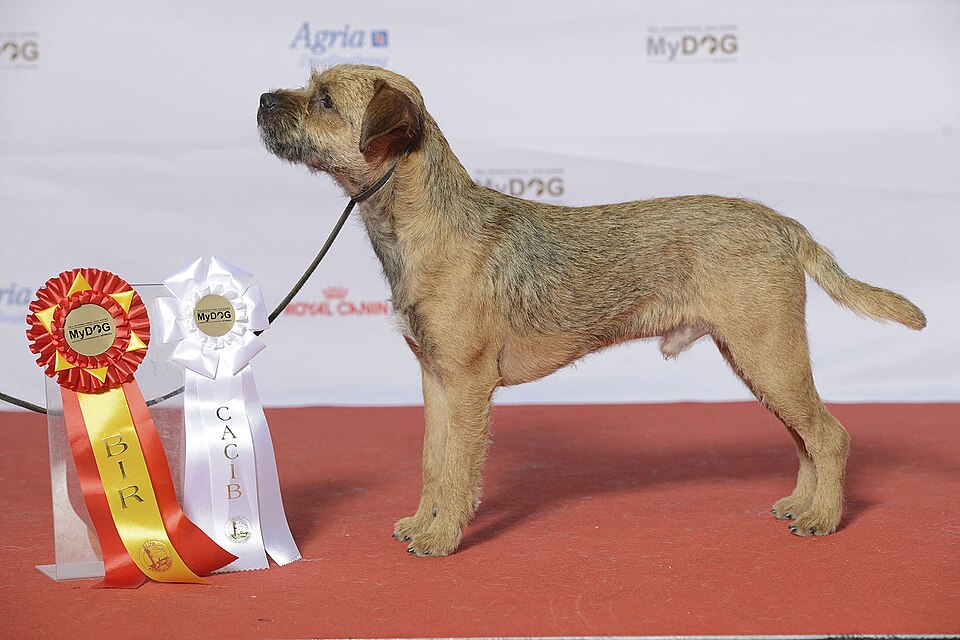
A Border Terrier stands in profile. Svenska Mässan, Wikimedia Commons

From the front, look for what the breed standard calls an “otter head.” The skull is fairly broad and flat between the ears, with a short, full muzzle. The small, V-shaped ears fold forward and hang close to the cheeks. In the portrait, pale whiskers partly hide the lips, but it’s still easy to see how little distance there is from the eyes to the tip of the nose. Coat color varies more widely. A Border Terrier may be red, wheaten, grizzle and tan, or blue and tan. [1]
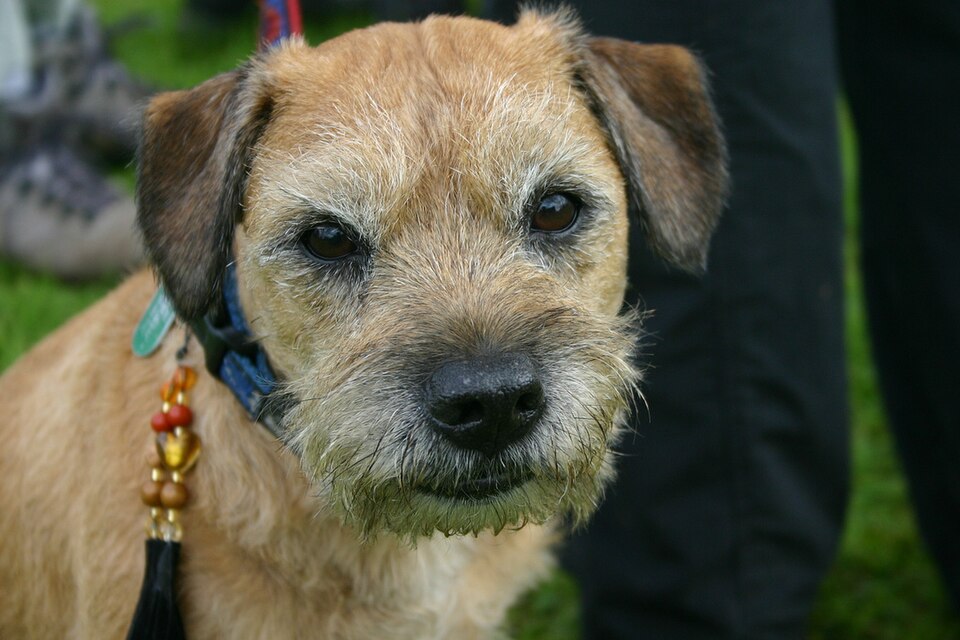
The portrait shows the Border Terrier’s otter head. John R., Wikimedia Commons[5]

Walk the fence line at ground level
Before letting a Border Terrier run loose in the yard, walk the perimeter and look down at the point where the fence meets the ground. Even with the gate firmly latched, a dog can dig a way out through soft soil. For a terrier built to work through narrow tunnels, a gap under the wire is a place to start digging. The American Kennel Club (AKC) recommends extending a backyard fence at least 18 inches (about 46 centimeters) underground where possible. Check beneath the gate, too, and anywhere the ground slopes away under a level stretch of fencing. [1]
Once the enclosure is secure, there’s room for a game of fetch. Walk the dog in on leash, latch the gate behind you, then unclip the leash and throw the ball toward the middle of the yard. If you find a section of wire lifting away from the ground, take a leashed walk that day. The Border Terrier Club of America cautions that some Borders will cross an electronic fence in pursuit of prey. If the gate needs to stand open while someone wheels a cart through, bring the dog indoors first. A squirrel darting past the gate can change the direction of the game in an instant. [1][2]
Make time to go out together every day
A Border Terrier can live in town without a yard of its own. Think through an ordinary workday. Who can take the dog out for a brisk walk, and who has time to play? The AKC gives a brisk half-hour walk or a game with a ball or flying disc as examples. You might take the brisk walk in the morning and leave time in the evening for the dog to sniff along the way. Set the pace and distance to suit its age and stamina. Some Borders find heat hard to tolerate. In hot weather, move the walk to a cooler part of the day and keep outings shorter. Back indoors, the dog can still enjoy hunting for a toy. [1]
Keep the leash clipped on in open areas. Borders enjoy working with people, but they can also follow a quarry independently. A dog that comes the moment you call in the living room may spot a cat before it hears you by the roadside. Start recall practice somewhere quiet. Let the dog wander a few steps, call its name once, and reward it when it turns and comes all the way back. Then let it explore again. In a securely fenced space, try calling while the ball is still in your hand. When the dog reaches you, throw it. Coming back can mean the next round of the game is about to begin. [1][3]
When a puppy comes home, plan for early socialization and puppy classes. One routine worth practicing as a family is answering the door. One person takes hold of the leash before another welcomes the visitor, so children know when they can open the door, too. Borders are generally friendly toward people, and many get along with other dogs. If you keep guinea pigs, hamsters, or rabbits, work out where and when those animals will have their daily time out. A terrier’s gentle greeting for a familiar person tells you little about how it will respond to a running rabbit. Can you close a solid door and give each animal its own space? [1][3]
How to care for the wiry outer coat
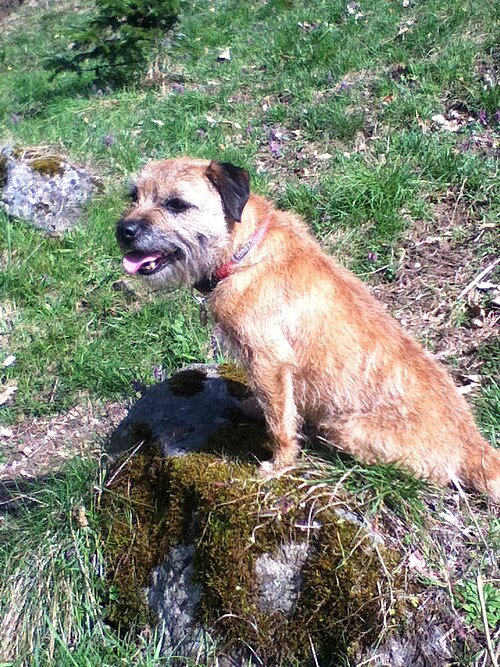
The outer coat stands out along the dog’s flank. Floris16, Wikimedia Commons[6]

In the outdoor photograph, sunlight picks out the slightly shaggy tufts along the dog’s side. Border Terriers once worked in the mist and rain of the border hills. They have two layers of coat: a soft, dense undercoat next to the skin and a layer of coarse, wiry hairs over it. The outer coat sheds dirt. After a muddy walk, a rub with a towel and a brush to loosen the remaining grit will usually do. Frequent baths can reduce the coat’s ability to repel dirt. Set aside a few minutes for a weekly brushing and take a look at the nails to see whether they need a trim. [1][2]
Allow more time when the coat is shedding. A quick brush tidies the surface. During the shed, old outer hairs loosen and can be worked out a little at a time by hand or with a suitable stripping tool. The AKC says this can take about half an hour a day during shedding season. If it’s your first time, ask a groomer who knows wire-coated terriers to part the coat and show you which hairs come away easily. Families who like a naturally shaggy look can also keep to a regular brushing routine. Leaving the old outer hairs in place may mean finding more of them around the house later. [1][2]
Ask for the parents’ screening records
When talking to a breeder about a puppy, ask to see both parents’ records for kneecap and hip evaluations, a heart examination, and an eye examination by a veterinary ophthalmologist. Also ask for their DNA test results for spongiform leukoencephalomyelopathy (SLEM). These are the breeding health checks listed on the AKC’s Border Terrier page. Each report should let you identify the dog, the check it received, and the result at the time. When you bring the puppy home, take its own medical records with you for your veterinarian. The parents’ reports document their screening. Your puppy’s examination tells the vet about the dog in front of them. [1][2]
Before deciding, picture the busiest day of your week. Who will clip on the leash for the morning walk? Where can the dog run safely that evening? When the coat starts to shed, where will grooming fit? A Border Terrier can make an ordinary walk interesting, nose down to investigate the verge one moment, ready to chase something up ahead the next. A good home for a Border is one where someone enjoys that curiosity and will still bend down to check the bottom of the fence before letting the dog off leash.
References
-
[1] American Kennel Club. Border Terrier Dog Breed Information.
-
[2] Border Terrier Club of America. FAQs ABOUT BORDER TERRIERS.
-
[3] Border Terrier Club of America. Why A Border Is Not For Everyone.
-
File:Grupp 3, BORDERTERRIER, Sweeping Farbror Barbro (24227702261).jpg
