The Alaskan Klee Kai’s ancestors pulled sleds in Alaska. Generations later, it was their smaller descendants that Linda Spurlin and her family chose as the starting point for a companion dog. Working with local husky lines in Alaska in the early 1970s, the family selected for balanced proportions, temperament and good health as well as size. Today’s Klee Kai still has the outline of a northern dog. Seen head-on, its most distinctive feature is the mask, with light and dark markings that mirror each other on either side of the face. The American Kennel Club (AKC) lists the breed in its Miscellaneous Class.[1]
How to recognize an Alaskan Klee Kai
Start with a standing dog whose four feet you can see. A Klee Kai stands 12 to 17 inches (about 30 to 43 cm), measured straight up from the ground to the withers, the highest point of the shoulders. In profile, the distance from the point of the shoulder to the point of the buttocks is a little longer than that height. The back is level, and the bushy tail curls loosely over it. Kukai’s photograph gives you two views at once. The sideways stance shows the line of the back beneath the tail. The turn toward the camera brings both upright triangular ears into view and shows how the broad head tapers toward the nose.[2]
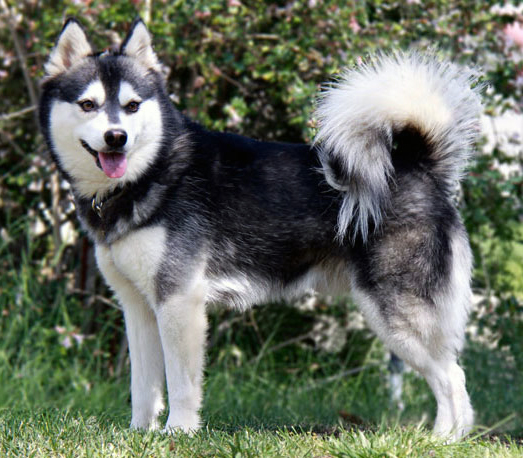
图:Kukai standing in profile. Jennifer Parks (Hyrel), Wikimedia Commons[4]

To pick out the mask, follow the markings from the base of the ears toward the nose. On Kukai, a dark stripe runs from the crown down between the eyes. White cheeks and a white muzzle frame the stripe, and a small pale patch sits above each eye. Look for that same balance of light and dark on another Klee Kai. The coat can be black and white, gray and white, or red and white. The almond-shaped eyes vary in color, and a single dog can have two different-colored eyes. Blue eyes alone tell you little. The pattern across the whole face and the proportions of the body give you more to go on.[1][2]
How can a dog that loves to chase explore safely?
The Klee Kai is light on its feet, with a moderate to high energy level. A dog that curls up beside someone it knows may be just as keen to go out and find something to do together. Think through your busiest weekday. Who will take the morning and evening walks? Which walk leaves time to stop and sniff? Once everyone is home, who would enjoy a game of fetch or hiding a toy for the dog to find? Daily walks and games can give a city dog room to exercise. A family that hikes can explore new trails together. Let the individual dog’s age, stamina and interest guide how much you do.[1]
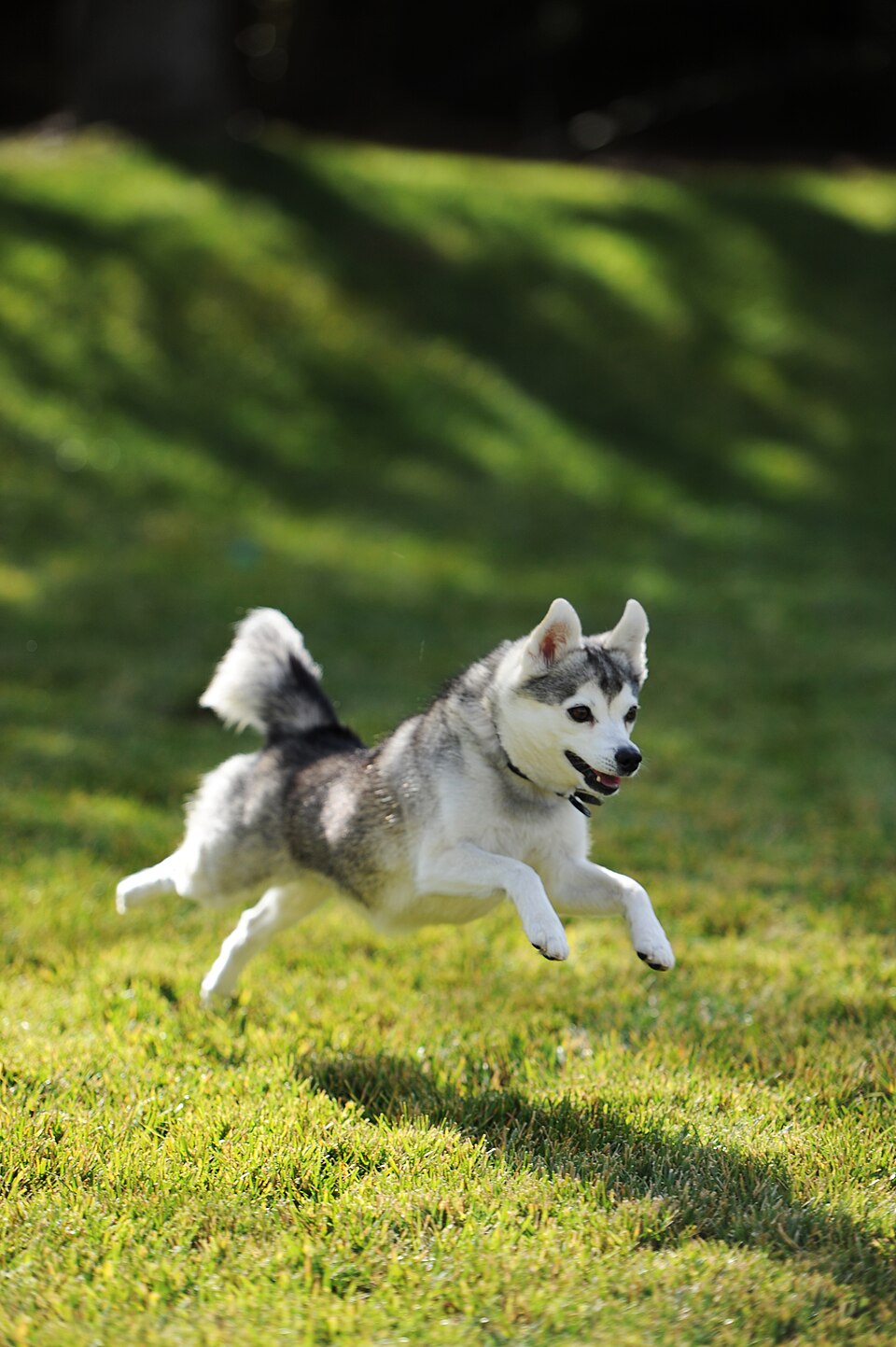
图:Nakoa in midair. Pauxcide, Wikimedia Commons[5]

Nakoa has all four paws off the ground. That agility makes for a good game of chase, but a small animal can set some Klee Kai off at a sprint. They can also dig, climb or squeeze through narrow gaps. Keep the leash on along open trails and choose a securely fenced area for running loose or chasing a ball. At home, walk the length of the fence. Look down for loose earth where the dog could dig under, then check the gaps beside the gate, anything that could serve as a foothold, and the latch itself. If someone props the side gate open to carry things through, decide who will keep the dog close during those few minutes.[1]
You can put that curiosity to work on walks. Start somewhere quiet and familiar. Say the dog’s name and give a small treat the moment it turns to look at you. On a leash walk, try the same exercise during a quiet stretch. Back indoors, hide a familiar toy somewhere easy to find and let the dog sniff it out. Change the hiding place as the game becomes familiar. Klee Kai enjoy a mental challenge and respond well to gentle training. Giving the reward as soon as the dog turns helps it learn which action earned the treat. Count training treats toward the day’s food.[1]
Talk through what will happen when the doorbell rings, too. Klee Kai form close bonds with familiar people and may hang back around strangers or in an unfamiliar situation. Ask guests to sit down and let the dog watch from a little way inside. Reward a calm glance at the visitor followed by a look back at you. Give the dog time to approach when it feels ready. These brief, easy introductions can start in puppyhood and continue into adulthood. In a busy home, a quiet place to retreat gives the dog a choice about joining each greeting.[1]
How deep should you brush a Klee Kai’s coat?
The longer hairs you see on a Klee Kai are the outer guard hairs. Underneath is a short, dense undercoat. On Kiskia, the fullness around the neck and tail is easy to see in profile. The layer you can miss when brushing lies close to the skin. Set aside time each week to part the outer hair and comb out loose undercoat a small section at a time. You can check the skin as you work. The undercoat usually sheds heavily twice a year, when you’ll notice more loose fur around the house. Use a grooming tool without blades. A dryer on a cool setting can also help lift out loose fur during a heavy shed. The coat sheds dirt readily, so let how dirty the dog gets guide bath time. Trim the nails regularly.[1]
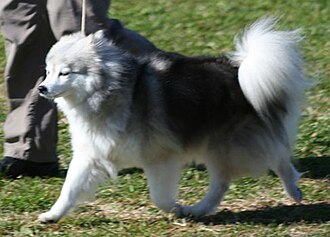
图:Kiskia’s coat in profile. Hyrel, Wikimedia Commons[6]

Which health records should you ask to see for each parent?
When you ask a breeder about a litter, request the screening reports for both the sire and the dam. The Alaskan Klee Kai Club of America recommends an evaluation for patellar luxation (a kneecap that slips out of place), a cardiac exam, an eye exam by a veterinary ophthalmologist and an evaluation for autoimmune thyroiditis. There is also a specific DNA test for factor VII deficiency, a blood-clotting disorder. The AKC breed page lists this test, and the breed club’s health statement identifies it as optional. Asking for each test by name helps you establish which screenings each parent had and what the results showed.[1][3]
If the breeder gives you a Canine Health Information Center (CHIC) number, read the individual results attached to it. To receive a number, the dog’s required screening results must be public, and those results can include abnormal findings. The parents’ records give you and the breeder something specific to discuss about the risks considered in planning the litter. A veterinary exam helps assess the puppy’s own health. Then picture the routines that will carry on after the puppy comes home. Who will make time for daily activity, keep the dog safe on walks and at open gates, and give it space when visitors arrive? Who will keep up with brushing and health care over the years? Those answers tell you more about the fit than the size of your home.[1][3]
References
-
[1] American Kennel Club. Alaskan Klee Kai.
-
[2] American Kennel Club. Official Standard of the Alaskan Klee Kai.
-
[3] Alaskan Klee Kai Club of America. AKKCOA Health Statement. September 30, 2024.
-
[4] Jennifer Parks (Hyrel). File:WOWAKK-Kukai-Alaskan-Klee-Kai.jpg. Wikimedia Commons.
-
[5] Pauxcide. File:Nakoa.jpg. Wikimedia Commons.
-
[6] Hyrel. File:Kiskia-longhaired-akk-jan2008.jpg. Wikimedia Commons.