The Bracco Italiano was bred to search Italian hunting grounds for game birds. On finding a bird, the dog would stand still and point, showing the hunter where to look. The work called for a dog that could cover ground and knew when to stop. The American Kennel Club (AKC) describes a gentle companion at home with remarkable stamina in the field. Both qualities appeal to runners looking for a dog to join them. The question is when to start. A young Bracco can already take long, graceful strides while its bones and joints are still developing.[1]
Seen from the side, a Bracco is about as long in the body as it is tall at the shoulder, or a little longer. The chest reaches the elbows, the forearms are well defined, and the thighs are muscular. Giotto, photographed standing on grass, shows those proportions well. Follow the line back from the bottom of his chest and it rises only slightly toward the belly before meeting the powerful hind legs. An adult Bracco stands about 21–27 inches (53–69 cm) at the shoulder and weighs 55–90 pounds (25–41 kg). When deciding who in the family will hold the leash, picture a dog of that size settling into its stride.[1][2]

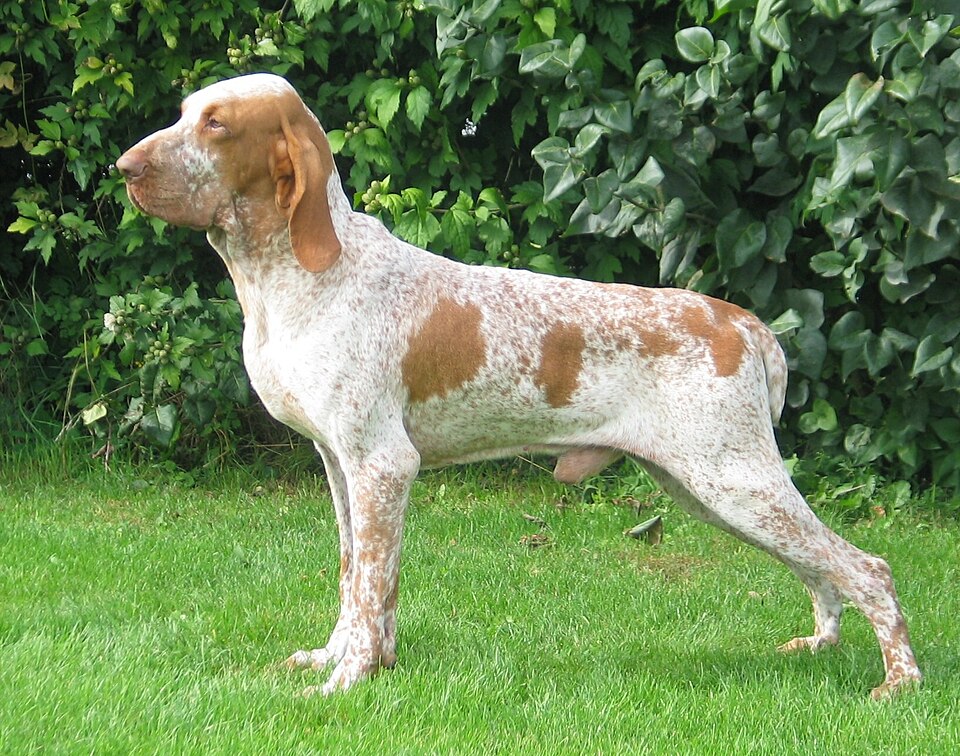
Giotto stands in profile. Gábor Essösy, Wikimedia Commons[2]
Look at a Bracco from slightly in front and other features come into view. The head has a distinctive outline. The muzzle is about as long as the skull, the upper lips hang over the sides of the lower jaw, and the long, soft ears are set well back and fall close to the cheeks. The short, dense white coat can carry broad orange or brown patches as well as fine flecks. On the orange-and-white dog pictured below, the patches on the head, neck and body catch the eye first. Look closer at the chest and legs to see the smaller markings.[1][3]

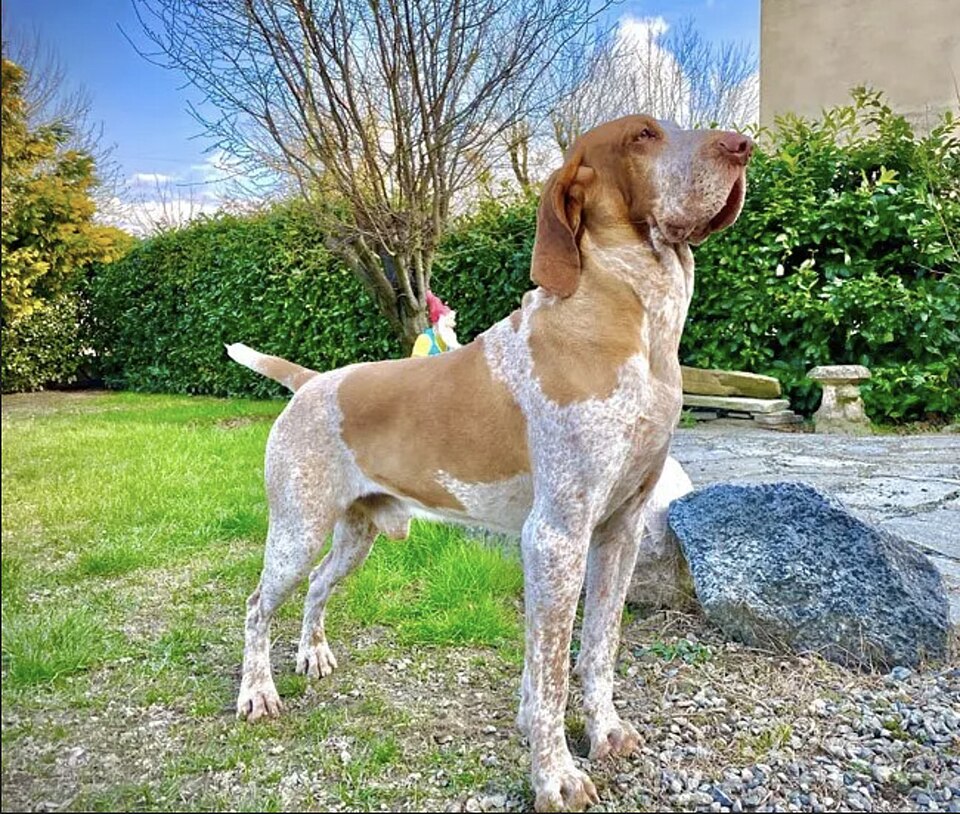
An orange-and-white Bracco lifts its head. Poggiwiki, Wikimedia Commons[3]
Learning to move together at a walk
At a dog show in Tallinn, a Bracco in the puppy competition trots beside its handler. One foreleg reaches forward as a hind leg stretches back, showing the length of the puppy's stride in a single frame. Taking that puppy on a road run of several miles would change the footing, the distance and the number of times its feet strike the ground. The AKC advises waiting until a Bracco is at least a year old before running the dog on hard surfaces such as concrete or asking it to do high-impact exercises such as repeated jumps.[1][4]

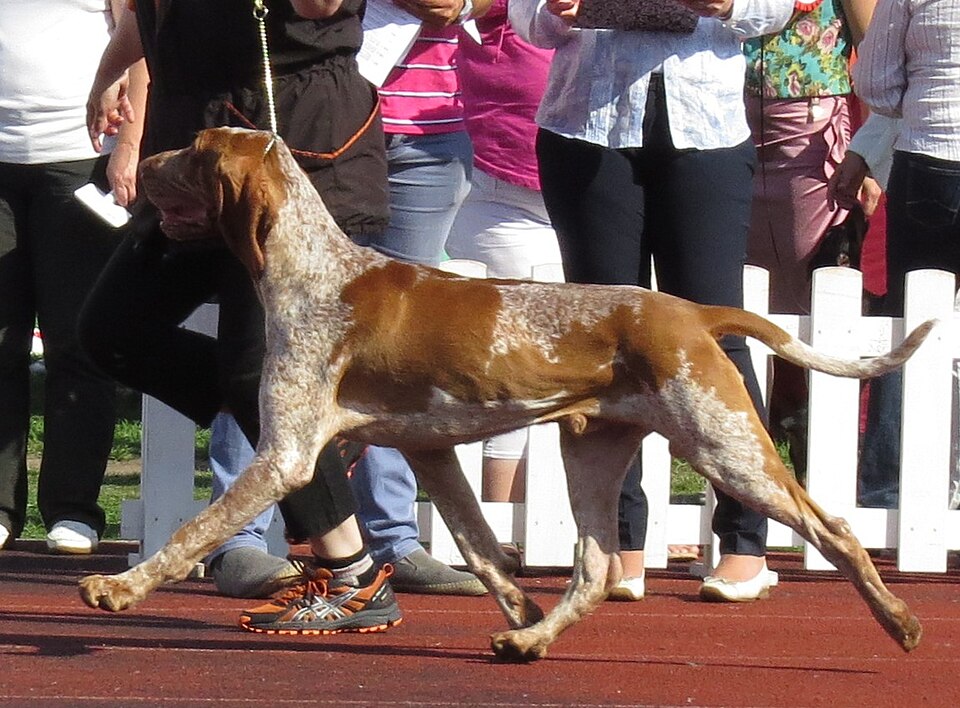
A puppy trots in the show ring in Tallinn. Томасина, Wikimedia Commons[4]
If you run every morning, take your puppy out on a separate walk. Choose a safe, level spot, walk a few steps together, then slow down. Reward the puppy when it turns to look at you. Change direction and give it a chance to find its place beside you again. The puppy gets to explore while learning to keep track of you, a skill it can use later when you jog side by side. If you hope to try agility together one day, turns and stops are already worth practicing with all four paws on the ground.[1]
How to use an adult Bracco's daily half hour
The first birthday is a good time to revisit the exercise routine. For a fully grown Bracco that already exercises regularly, jogging with you is one option. The AKC describes the breed as moderately to highly energetic and recommends at least 30 minutes of exercise a day, preferably more. If your dog is used to walks, try jogging for a short stretch along a familiar route, then ease back to a walk. Let the dog's health and usual activity guide the distance. Even on a day when your own training plan calls for five kilometers, you can finish the run on your own.[1]
A Bracco also needs time each day to do something with the family. On an evening walk, practice walking together for part of the route. Give a cue just before a corner, reward your dog for turning with you, then let it stroll for a while. Families who enjoy following a course might like rally, a sport in which dog and handler heel, halt and turn together at a series of stations. Half an hour alone in the yard gives a Bracco room to move. A game with you also gives this hunting dog a partner whose movements are worth watching.[1]
To see how a Bracco would fit into your home, picture your busiest weekday. Who can take the dog out in the morning? Who has time in the evening to slow down and practice a turn? Who can stay nearby while the dog runs freely in a securely enclosed space? A Bracco is generally responsive and can also have ideas of its own. Agree on one cue for stopping and reward the dog promptly when it stops. That way, whoever takes the leash tomorrow can pick up where today's walk left off. If the only exercise time in the family schedule is half an hour on a treadmill, the dog will need a separate place in that schedule for outings and company.[1]
Looking after a Bracco's health
The short coat takes little work after an outing, and an occasional bath is usually enough. Make a habit of gently lifting each long ear to look underneath for dampness or unusual discharge. A puppy can get used to having its ears handled early. For routine cleaning, use the solution and schedule your veterinarian recommends. Brush the dog's teeth regularly, and check and trim the nails before they grow long enough to split. Count treats given on walks toward the day's food allowance, especially when several family members take turns training.[1]
When choosing a puppy, its expression and gait can tell you only so much. The Bracco Italiano Club of America recommends hip, elbow, eye and kidney screening for breeding dogs. Ask the breeder for records for each parent. Look for hip and elbow evaluations and an eye examination that covers conditions such as inward- or outward-turning eyelids and cataracts. For the kidneys, look for two results from the six months before breeding: a serum creatinine measurement and a urine protein-to-creatinine ratio. Those records tell you what was checked and when.[5]
Your Bracco's first birthday is also a useful time for a conversation with your veterinarian. The club encourages annual kidney testing from age one for all Bracchi Italiani, including family companions. Bring the dog's health records and describe an ordinary walk. How long are you out, what surfaces do you cover, and where would you like to start jogging together? The parents' screening results provide family history. Your dog's own development, health and daily activity give you and your veterinarian a basis for deciding when to add distance.[1][5]
References
-
[1] American Kennel Club. Bracco Italiano.
-
[2] Gábor Essösy. File:Giotto BI.jpg. Wikimedia Commons, 2008.
-
[3] Poggiwiki. File:Bracco italiano Polceveras.jpg. Wikimedia Commons.
-
[4] Томасина. File:Bracco Italiano in Tallinn.JPG. Wikimedia Commons, 2013.
-
[5] The Bracco Italiano Club of America. Health Statement. November 16, 2025.