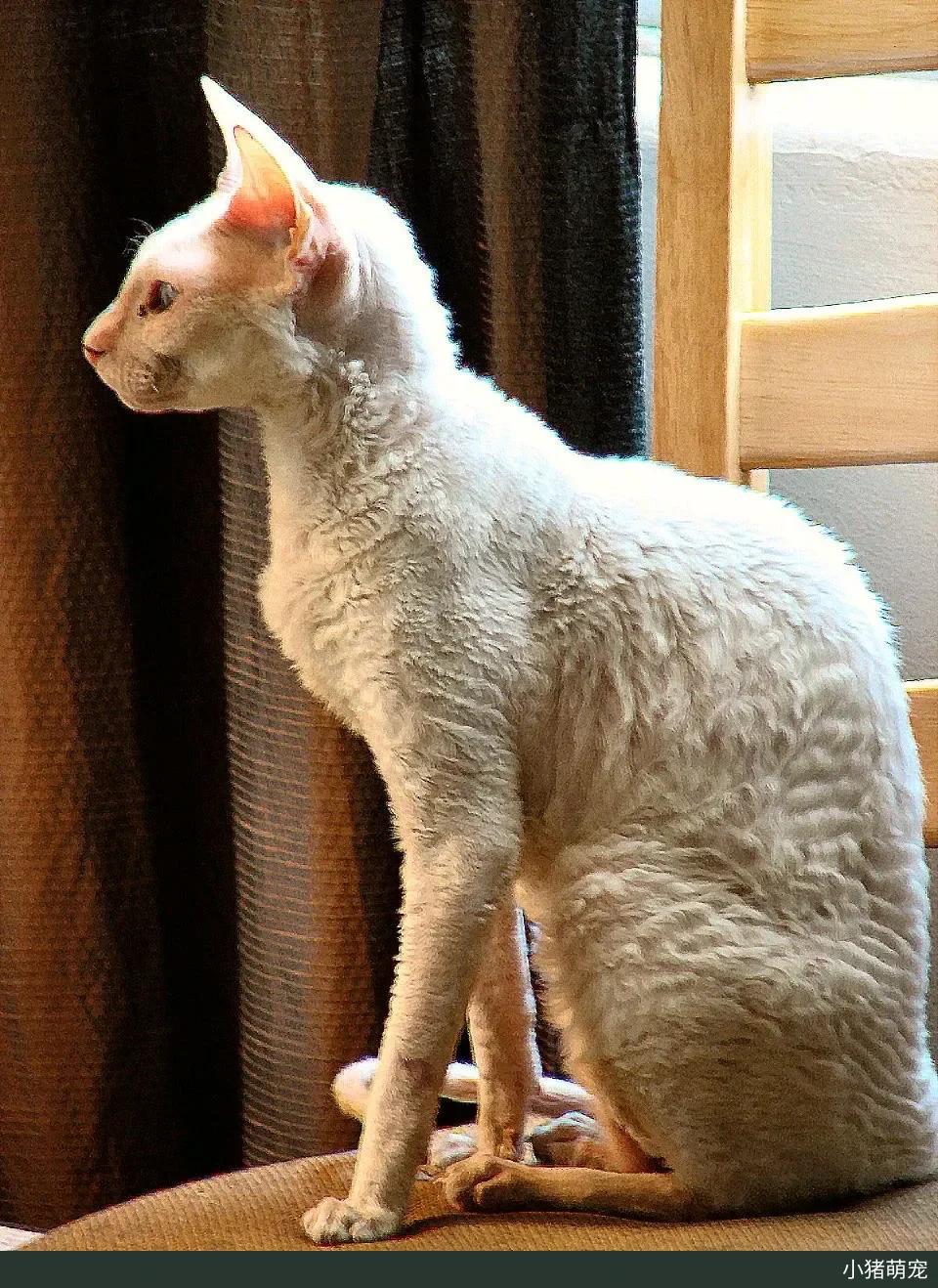
A white Cornish Rex sitting sideways, with slender limbs, tall large ears, and fine wavy curls clearly visible. Figure: Paul Lewis / Wikimedia Commons, CC BY 2.0.
The Cornish Rex originated with a curly-coated male kitten born on a Cornwall farm in 1950. Its body is long and lean, with high legs and a tucked waist—often compared to a “feline greyhound”; its short curls without guard hair feel especially soft, but also leave it more sensitive to cold and sun. Active and affectionate, they are often seen as a relatively hardy breed, yet about one-third are blood type B, so blood typing before breeding is essential.
Origin and history
On 21 July 1950, on a farm on Bodmin Moor in Cornwall, England, Nina Ennismore’s queen Serena produced five kittens; one male had fine curly hair and was named Kallibunker—the foundation of the Cornish Rex. Accounts of his color differ: GCCF and CFA say cream, TICA says red-and-white; GCCF also notes that his sire was uncertain. A veterinarian advised consulting geneticist A. C. Jude; on his advice, Kallibunker was backcrossed to his mother, producing more curly kittens, including a male, Poldhu, who later entered the breeding program. Ennismore had kept Rex rabbits and borrowed the name “Rex.”
The early population was small; breeders later introduced Burmese, Siamese, British Shorthair, and ordinary domestic cats to widen the gene pool (associations list slightly different breeds). In the mid-1950s the breed reached the United States: CFA records a California breeder buying a pair in 1956; TICA says a queen, Lamorna Cove, arrived the following year. Associations then recognized the breed: CFA accepted registration in 1962 and championship in 1964; GCCF formally recognized it in 1967; FIFe’s standard notes recognition in 1968.
The curls come from a spontaneous mutation inherited as an autosomal recessive: a kitten must receive one copy from each parent to show the coat. A 2013 PLOS ONE study found the cause: a 4-base deletion in LPAR6. All 39 unrelated Cornish Rex tested carried two copies of the mutation. The Devon Rex’s curls come from a different gene, KRT71—similar names, different mutations.
Appearance and temperament
What stands out first is the short curl lying close to the skin. Without coarse guard hair, waves run from crown to tail tip; CFA calls it a “marcel wave,” TICA a washboard; whiskers and eyebrows are often curly or bent too. CFA’s standard awards 40 of 100 points to the coat, requiring it to be curly, dense, and soft. In body, the back arches naturally, the waist is tucked, limbs are long, the head egg-shaped, ears large and set high, eyes oval—hence comparisons to greyhounds or Whippets. Though the frame looks fine-boned, associations stress solid muscle; they feel heavier than they look. TICA and GCCF give the same weight references: about 5–7 lb (about 2.3–3.2 kg) for females and about 8–10 lb (about 3.6–4.5 kg) for males. All colors and patterns are accepted.
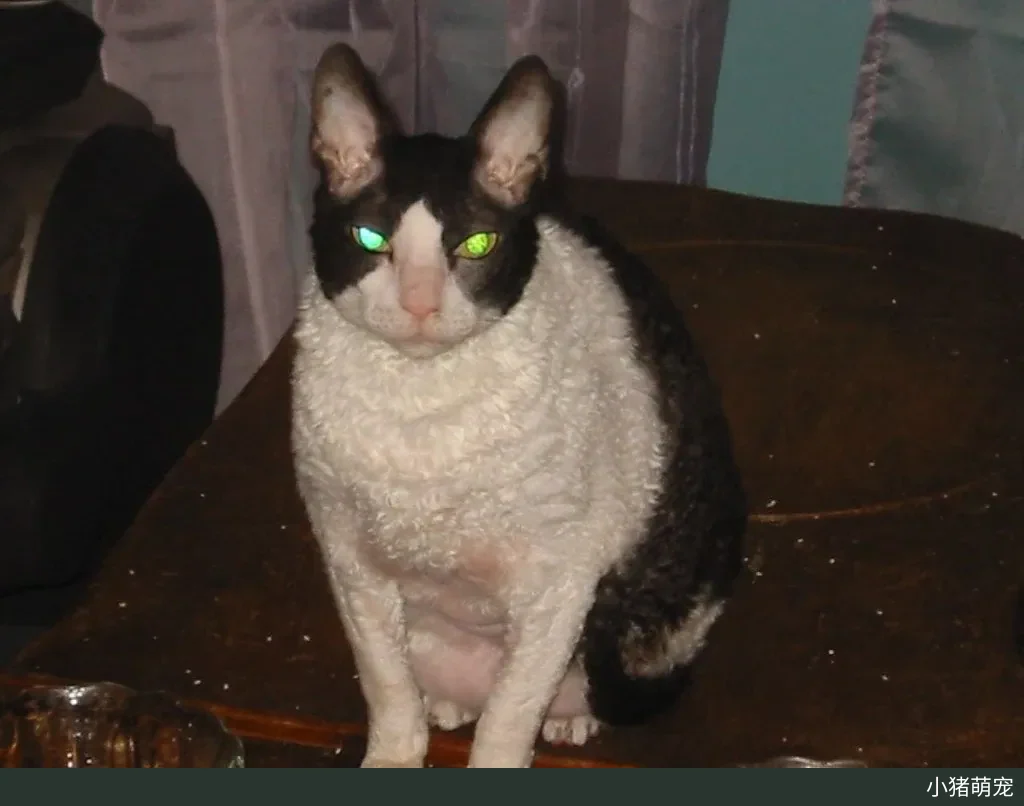
A black-and-white bicolor Cornish Rex sitting face-on, with fluffy fine curls on the white chest; the green eye glow is camera flash reflection. Figure: Boska / Flickr, CC BY 2.0.
On temperament, CFA, TICA, and GCCF agree closely: smart, energetic, playful, still kitten-like as adults. Many Cornish fetch toys and follow their people; CFA says they are often called “Velcro cats” because they want to stick close. They are usually not loud, but dislike long solitude; TICA suggests considering a companion if the household is away for long workdays. Association materials also say they usually get along with children and cat-friendly dogs. These are breed-level tendencies; each cat still depends on individual personality and early socialization.
Common health issues
Folded ears, short legs, and short faces—often debated for skeletal and craniofacial structure—are not the Cornish Rex’s defining trait; that is the coat, and related research points to hair structure. CFA even writes that it has “no hereditary health problems,” but that is an association claim without accompanying data. TICA is more cautious: most people consider it generally healthy, while noting possible predisposition to hypertrophic cardiomyopathy (HCM) and patellar luxation. We found no incidence data for either in this breed, so one can only say they “warrant attention,” not that they are “common.” Lifespan estimates also diverge: TICA says 9–13 years or more; GCCF about 16 years or more.
The curl itself has a cost. Without guard hair, the coat is thinner and more fragile: CFA and TICA both warn of chill and sunburn; GCCF warns against rain, because the coat soaks through quickly. The 2013 genetic study also notes mild hypotrichosis in the breed; most individuals have bent, twisted whiskers that break easily. CFA’s standard penalizes sparse coat or bald patches. If you see clear local bald spots, red skin, or recurring itch, see a veterinarian—do not dismiss it as “normal for the breed.”
Blood type is the point worth remembering most. Cats mainly have types A, B, and AB. A 2022 PLOS Genetics study genetically typed more than 10,000 cats; among 106 Cornish Rex, 33% were type B and 0.9% type AB. Researchers note that mismatched parental blood types in breeding can cause neonatal isoerythrolysis, a major cause of fading kitten syndrome and neonatal death. GCCF’s Rex Breed Advisory Committee therefore advises blood typing before breeding. The study samples came from commercial genetic testing, more than half from the United States, so they may not represent Cornish Rex everywhere. Even if you do not plan to breed, knowing blood type helps if a transfusion is ever needed.
Care essentials
- Warmth and sun protection: They chill easily; provide a warm bed in winter—CFA even suggests considering a sweater—and avoid long sun exposure.
- Grooming: The coat barely needs brushing; GCCF says stroking by hand is usually enough. CFA notes ears collect wax and need frequent cleaning; TICA mentions ears and toes can get oily. After an occasional bath, towel-dry only; CFA especially warns against hair dryers, which flatten the curls.
- Diet control: CFA says they have large appetites; TICA warns they overeat easily. Feed measured portions and weigh regularly so the “greyhound” does not become a “round ball.”
- Companionship and activity: High energy needs daily interactive play, cat trees, and puzzle toys; CFA advises securing fragile items. Not suited to long alone time.
- Allergies: TICA states clearly that no truly hypoallergenic cat exists. Friends allergic to cats should not assume low shedding means no allergy—spend real time with the cat before bringing one home.
- Health management: Know your cat’s blood type; keep checkups, vaccines, and deworming on schedule; if getting a cat from a breeder, ask about breeding cats’ blood-type records.
References
-
The Cat Fanciers' Association. Cornish Rex (breed profile and standard; page undated; accessed 2026-10-17)
-
The International Cat Association. Cornish Rex (page undated; accessed 2026-10-17)
-
The Governing Council of the Cat Fancy. Cornish Rex (page undated; accessed 2026-10-17)
-
Fédération Internationale Féline. FIFe Standards: Category 4 (2026 edition, effective 2026-01-01; includes Cornish Rex standard)
-
Gandolfi B, et al. To the Root of the Curl: A Signature of a Recent Selective Sweep Identifies a Mutation That Defines the Cornish Rex Cat Breed. PLOS ONE, 2013, 8(6): e67105.
-
Anderson H, et al. Genetic epidemiology of blood type, disease and trait variants, and genome-wide genetic diversity in over 11,000 domestic cats. PLOS Genetics, 2022, 18(6): e1009804.