In Switzerland’s Entlebuch valley, dairy cattle went up to the high pastures for summer and came back down before winter. Entlebucher Mountain Dogs traveled the mountain paths with them, watching over the grazing cattle and keeping the herd together on the trail. To move a reluctant cow, a dog might nip at a hind heel or spring against the animal with its body. A cow can take that kind of nudge. A child just learning to run can lose their footing in an instant. That difference matters when you bring a cattle dog into a family. [1][2]
The Entlebucher is the smallest of the four Swiss mountain dog breeds, standing about 16 to 21 inches (41 to 53 centimeters) at the shoulder. From the point of the shoulder to the rump, the body is longer than the dog is tall. The chest reaches almost to the elbows, and the legs are short and sturdy. In the standing photograph, you can trace the chest down to the forelegs, then follow the line of the body back to the muscular hind legs. Picture the dog on a slope, moving in close to a cow’s feet, springing clear, then finding its footing and keeping pace. [1]
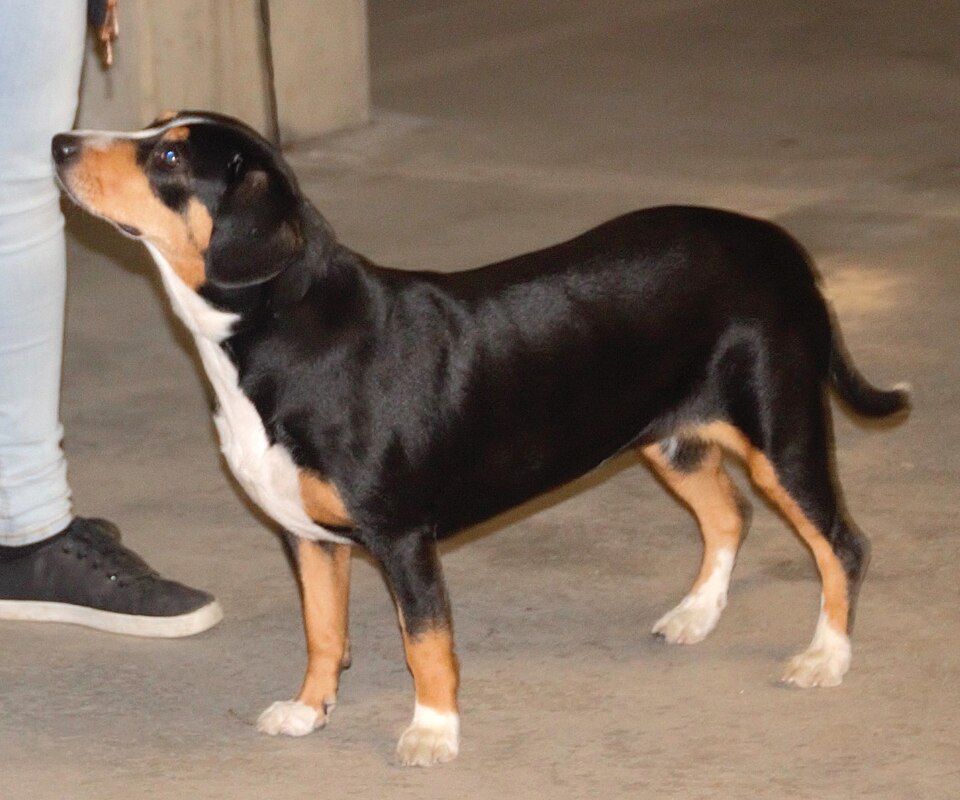
An Entlebucher Mountain Dog stands in profile. Canarian, Wikimedia Commons[4]

Seen from the front, the three colors are easy to place. Black covers the crown and ears. A tan patch sits above each eye, and a white blaze runs down the middle of the forehead to the muzzle. The ears are set high and fold down to slightly rounded tips. Several Swiss mountain dogs share this coloring. To recognize an Entlebucher, look at the facial markings together with the short, close-fitting coat and the slightly elongated body. [1]
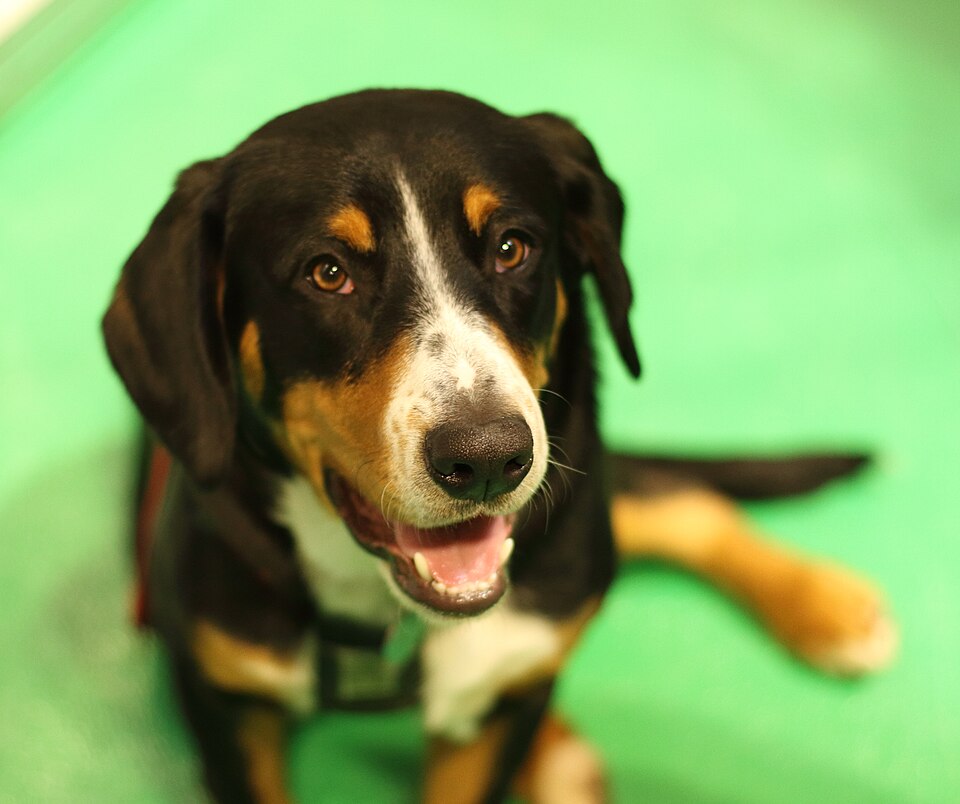
The Entlebucher has folded ears and tan eyebrow markings. adam w, Wikimedia Commons[5]

Making room for exercise on a workday
Herding took stamina, and the dog also had to keep track of the cattle and the people moving with them. The American Kennel Club (AKC) gives at least an hour of daily exercise as a guide for this energetic breed. To see how that fits your household, pick one of your busiest workdays. Who can take the dog for a walk in the morning? Who can head out again around dinner, and who can step in if someone works late? A fit adult dog can join you on a long walk or hike. For a puppy, start with distances and games it can comfortably manage now. [1][2]
On a walk, leave time for the dog to follow its nose. At a few corners, practice changing direction together. In a securely enclosed space, you can play fetch and ask the dog to come back to your side and wait for a signal before the next throw. A dog that enjoys following a scent may take to tracking. Choose something the dog likes doing and someone in the family looks forward to sharing. When you work out how much exercise you can offer, the riverside path you walk every day counts for more than a mountain trail you visit twice a year. [1][2]
Teaching the dog to come to your side
The National Entlebucher Mountain Dog Association notes how much force these dogs can bring to play. Even a puppy may nip a playmate or barrel into them. Start with one action the dog can learn at home. When you say “here,” it comes to stand beside your leg. In a quiet room, take one step away and give the cue. As soon as the dog reaches your side, give it a small treat right there. Then take two or three steps, stop, and invite it to join you again. If everyone uses the same word and delivers the treat beside their leg, the dog can learn exactly where to stand. [1][2]
Once the dog knows the cue, introduce a person moving past. One adult holds the leash while another walks slowly by at a distance. If the dog notices the walker and still comes to your side when called, reward it there. If it fixes its gaze on the walker and lunges against the leash, move farther away and begin the next attempt with more space. Change one thing at a time. Practice with someone walking past before asking them to pick up the pace. This gives the adult a way to guide the dog before it gives chase, and the children can stay out of the exercise. [1][2]
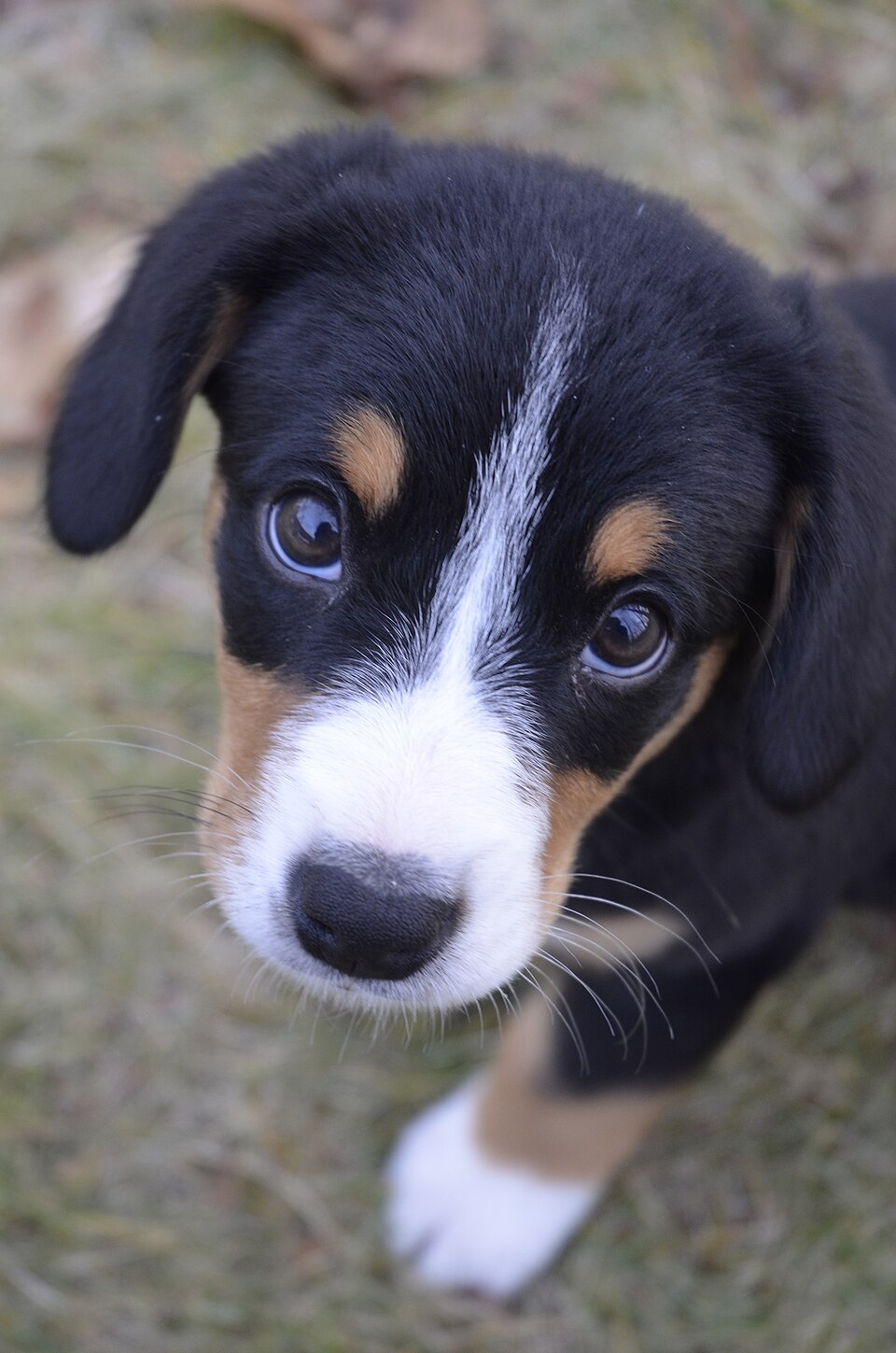
An eight-week-old puppy shows its white blaze and paws. Ziegelhausen, Wikimedia Commons[6]

When children are ready to run, the simplest arrangement is often to give the dog its own space before the game begins. While the children kick a ball in the yard, the dog can stay with an adult on the other side of a gate. Once the game is over, everyone can go for a walk together. Older children who understand how to wait, take turns, and put a toy down can more easily share play under adult supervision. With a toddler, think about the space and the hands you have available. When an adult is busy steadying the child, does the dog have a familiar place to rest? When only one adult is home, can the child and dog each enjoy their own space? [2]
A dog whose job once included watching over a herd may also take a keen interest in the front door. To help a puppy get used to visitors, start with one quiet guest. Give the puppy room to watch the person come in and let it approach when it is ready. That is an easier greeting to manage than several people reaching for the puppy at once. If you are considering an adult dog, ask its caregiver what it does when a visitor arrives, when someone runs past, and when a game ends. Those details tell a family more about living with this particular dog than a general assurance that it likes people. [1][2]
Beneath the short outer coat
In the side view, the glossy black outer coat lies close to the back. Beneath it is a dense undercoat that sheds. After a muddy outing, a damp towel will take dirt off the surface. Regular brushing with a firm, closely bristled brush lifts out loose hair. The AKC also advises checking the folded ears weekly, trimming the nails monthly, and gradually getting the dog used to having its teeth cleaned from an early age. If you often use food rewards outdoors, set aside a little of the day’s food before you leave. That makes it easier for the next person on dog duty to keep track of how much the dog has eaten. [1][2]
Before bringing home a puppy, ask to see the health records for both parents. The breed association lists hip and kneecap evaluations, an examination by a veterinary ophthalmologist, and a DNA test for a form of progressive retinal atrophy called prcd-PRA. On each report, look for the dog’s identity, the test performed, the date, and the result. The eye examination records what the specialist could see at the time. The DNA test tells you whether the dog carries a particular inherited variant. It is also worth asking about a family history of Entlebucher urinary syndrome, which is associated with ureters that open in an abnormal location. Keep copies for the veterinarian who will care for your dog so that you can discuss what to watch for over time. [1][3]
References
-
[1] American Kennel Club. Entlebucher Mountain Dog.
-
[2] National Entlebucher Mountain Dog Association. Common Questions About Entlebuchers.
-
[3] National Entlebucher Mountain Dog Association. Health Statement for Entlebucher Mountain Dog (EMD). Revised December 2017.
-
File:Crufts 2019- NEC, Birmingham- 08-March 2019 - 33455424448.jpg