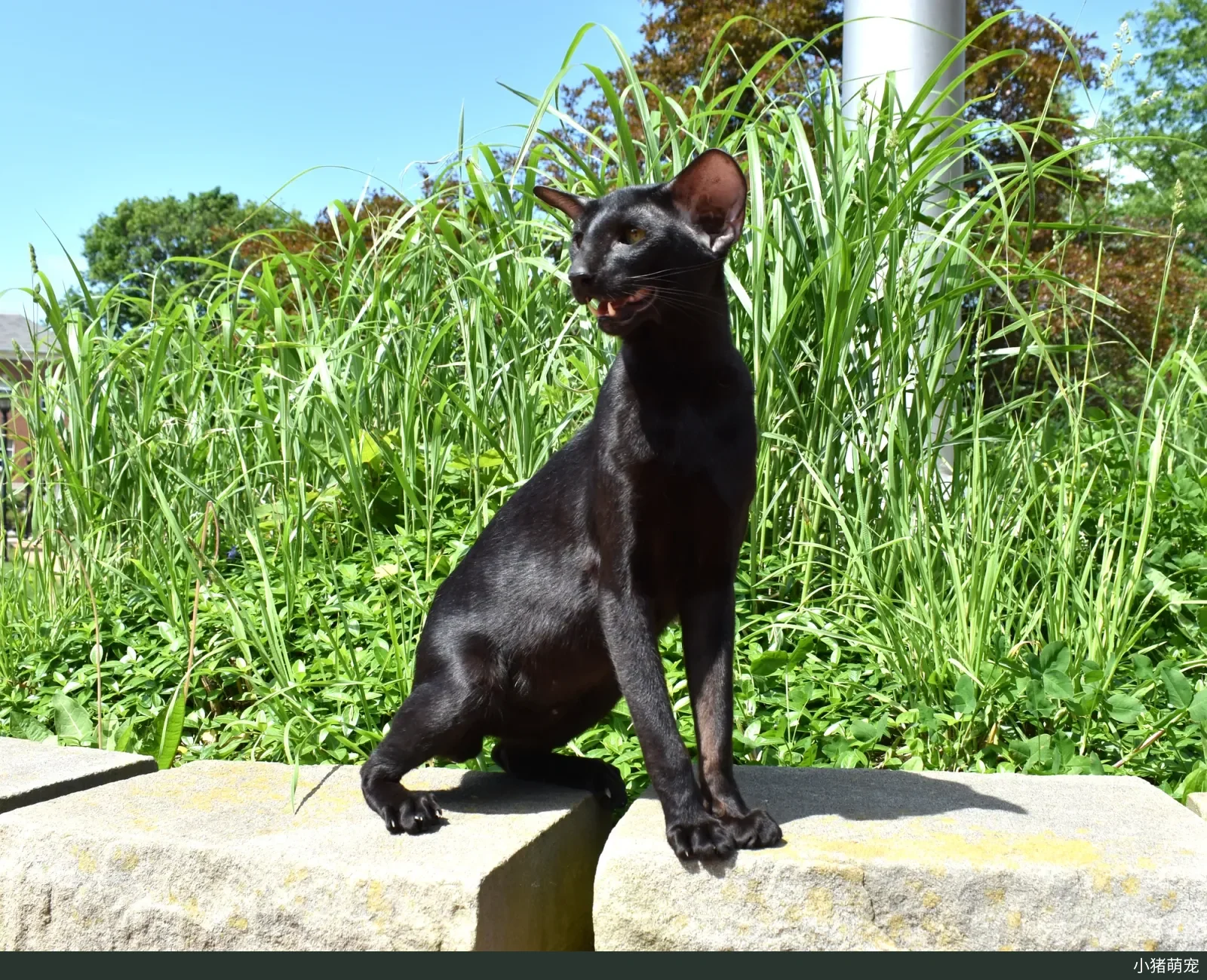
A modern-type black Oriental Shorthair male, photographed in May 2019. Author: Felinlove; source: Wikimedia Commons; license: CC BY-SA 4.0
The Oriental Shorthair is often described as “a Siamese without points”: the same wedge head, large ears, almond eyes, and elongated body as the Siamese, but dressed in solid, tabby, tortoiseshell, smoke, and more than a hundred other colors and patterns. It originated in Britain in the 1950s; temperament is warm, talkative, and inseparable from people. Drawing on breed-association and veterinary research sources, this piece covers origins, looks, temperament, health risks, and care points.
Origins: a colorful family bred from the Siamese
The Oriental Shorthair was developed in Britain after World War II. Per the Governing Council of the Cat Fancy (GCCF) breed history, in 1951 Baroness von Ullman began a program aimed at an “Oriental-type” solid chocolate cat: first a chocolate-point Siamese male was bred to a black non-pedigree cat, and Mrs Hargreaves later added her own Siamese and Russian Blues. In October 1952 the solid chocolate male Elmtower Bronze Idol was born, becoming the starting point of today’s “Havana” color line. Foreign Lilac and Foreign White followed, and British Shorthair, Abyssinian, and ordinary house-cat blood were introduced along the way.
TICA explains the genetics behind it: the Siamese “point” pattern—darker face, ears, limbs, and tail—is recessive; hybrid offspring color up over the whole body; backcrossing to Siamese for several generations then produces cats almost identical in type to the Siamese but in different colors. At first each color was named as a separate breed; when colors proliferated, all non-pointed individuals were gathered into one breed. Recognition dates differ by association: FIFe recognized the Oriental Shorthair in 1959; in the United States CFA accepted registration in 1974, Championship status in 1977, and the longhair in 1988, renaming the breed Oriental with short and long coats competing in separate divisions. Interestingly, early “Havanas” imported to the United States later took a separate path and became the independent Havana Brown—not the same as a chocolate Oriental Shorthair.
Looks and temperament
Per CFA’s breed standard, the ideal Oriental Shorthair is long, tapering, lithe, and muscular. The head is a long wedge: a triangle from nose tip to the tips of both ears; in profile, a straight line from the top of the head to the nose tip; ears large and broad at the base; eyes medium-sized almonds slanted toward the nose. The body is a long fine tube on fine bone with firm muscle, hips no wider than the shoulders; legs long and slender, hind legs slightly longer than the forelegs; the tail long and tapering to a fine tip. The coat is short, fine, glossy, and close-lying. Standard eye color is green; white and white bicolor individuals may have blue, green, or odd eyes. In the FIFe system, Oriental Shorthair, Oriental Longhair, Siamese, and Balinese share one type standard.
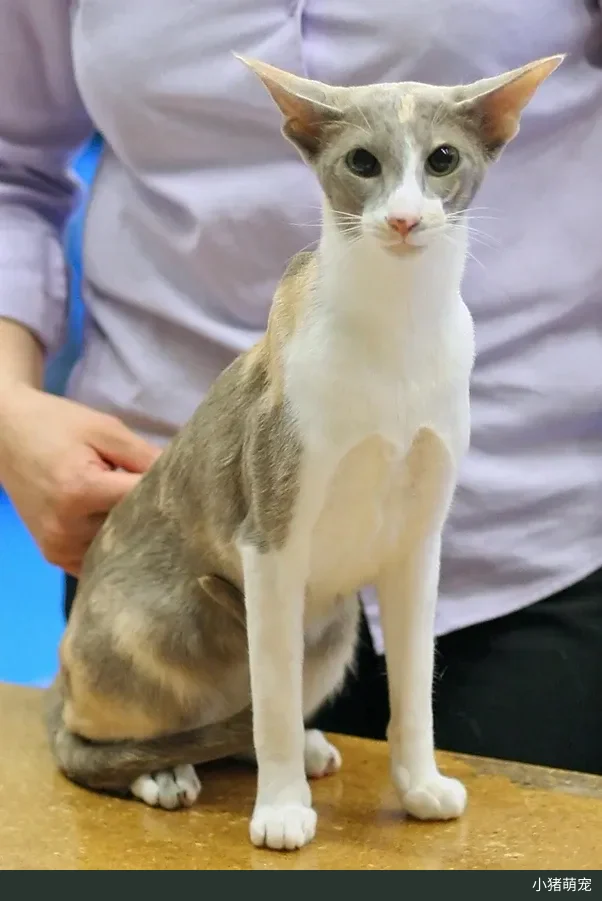
Lilac-tortoiseshell-and-white Oriental Shorthair IC Desmodus Lilac Negrita, photographed 29 September 2007 at a FIFe show in Porvoo, Finland. Photo: Heikki Siltala (catza.net); source: Wikimedia Commons; license: CC BY 3.0
CFA’s standard calls color the breed’s “reason for being.” Counting methods differ: CFA says combinations of color, pattern, and coat length exceed 600; TICA lists 281 colors, each in short and long coat. On weight, TICA gives roughly 5–8 pounds (about 2.3–3.6 kg) for females and 8–12 pounds (about 3.6–5.4 kg) for males; GCCF’s average is 8–14 pounds (about 3.6–6.4 kg). TICA also notes that kittens mature slowly and are not fully grown until 18–24 months.
Several associations describe temperament in closely matching terms: intelligent, active, talkative, and very people-oriented. CFA’s summary is “vocal, affectionate, and active, sometimes insistent,” warning that withdrawn attention may leave the cat gloomy; TICA says many Orientals play retrieve, love jumping and exploring cabinets and high places, stay kitten-like for life, and are generally not suited as an only cat; FIFe also writes that they dislike solitude and usually prefer living in pairs or groups. TICA adds that a minority bond to one person and hide from visitors. These are breed-level generalizations; individuals still differ, so spend time with a cat before adopting or buying.
Health risks and genetic issues
First, the genetic controversies people often ask about—folded ears, short legs, shortened faces driven by the trait itself—do not involve Oriental Shorthair breed features. The standard specifically requires a long, straight nose; CFA also lists “open-mouth breathing due to nasal obstruction or malocclusion” as a disqualification. TICA does say frankly that Siamese-group type is “an extreme”; the genetic risks Orientals truly need to watch come mainly from the gene pool shared with the Siamese.
First is progressive retinal atrophy (PRA). Per UC Davis Veterinary Genetics Laboratory (UC Davis VGL), the rdAc mutation in CEP290 causes late-onset blindness as an autosomal recessive: cats are born with normal vision; degeneration can be detected by electroretinogram around 7 months of age; most go blind by 3–5 years; there is currently no treatment. That course description comes mainly from studies in Abyssinians and related breeds, but the laboratory notes that this mutation’s frequency in Siamese is about 33% (the page does not state the statistical basis), posing a significant health risk to the Siamese group including the Oriental Shorthair. Fortunately it can be DNA-tested from a buccal swab; when two carriers are mated, about 25% of kittens are expected to be affected. CFA and GCCF both advise confirming parents’ test results with the breeder.
Second is amyloidosis—abnormal protein (amyloid) deposited in the liver and other organs; CFA says it can cause hepatic and other problems. A 1997 Dutch study reviewed 194 Siamese cats (including Oriental color types) submitted for necropsy between 1987 and 1994; 12 (6.2%) were diagnosed with amyloidosis, often with enlarged, pale livers and hemorrhage, and pedigree analysis suggested a familial pattern. Note that this rate comes from necropsy cases and cannot stand for breed-wide prevalence. CFA notes that amyloidosis may be inherited or acquired and that genetic markers are still being sought; TICA also says no usable test exists yet. Before taking a cat home, ask the breeder whether the disease has appeared in the lines.
In addition, GCCF mentions flat-chested kitten syndrome in Orientals. TICA warns that the breed is more sensitive to anesthesia and that veterinarians should be told before routine procedures such as neutering or dental cleaning; that is an association caution without cited study data on the page. On lifespan, GCCF gives 12–15 years; TICA writes 10+ years and notes individuals living past 20.
Day-to-day care and choosing a cat
Coat care is easy. CFA suggests a weekly rubber brush for shorthairs; TICA suggests a stainless-steel comb every few weeks, or stroking head to tail with a damp hand to lift loose hair. TICA also advises weekly nail trims, cleaning around the eyes and ears, brushing with a veterinarian-approved pet toothpaste, and periodic professional dental cleaning.
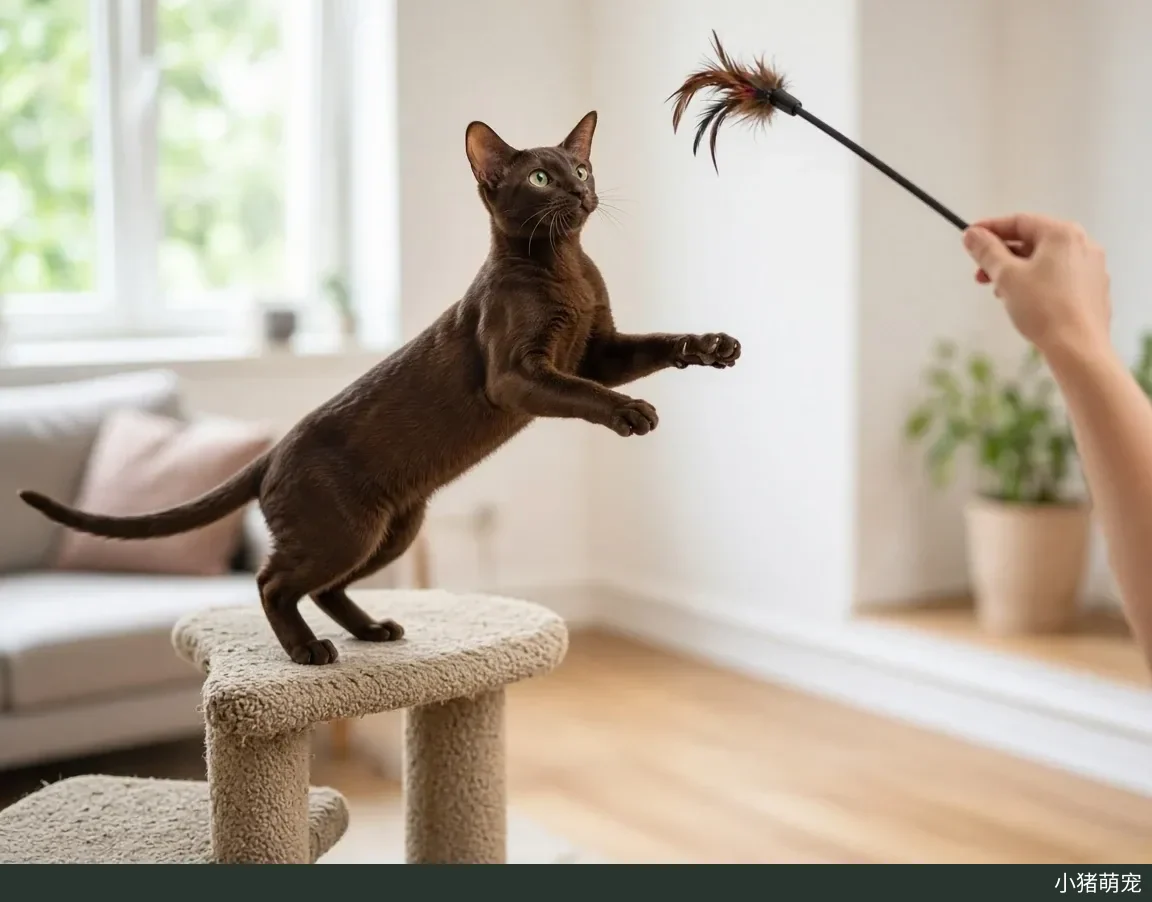
A chocolate Oriental Shorthair stands upright on a living-room cat tree, batting at a feather wand in a person’s hand. AI-generated illustration, not a real photograph—only to suggest the breed’s playful, people-oriented nature.
What really takes investment is company and activity. Oriental Shorthairs love to jump and play; cat trees, wand toys, and retrieve games help burn energy, and TICA says they suit feline agility training. If the home is empty for long stretches during the day, seriously consider whether a compatible second cat can keep company. On diet, TICA suggests feeding adults at least twice a day and kittens three to four times, with fresh water, and placing the water bowl at least 3 feet (about 0.9 m) from food; TICA tends to favor wet food, but what and how much should be decided with a veterinarian for the cat’s age and condition. Finally, when collecting a cat from a breeder, ask for the parents’ PRA DNA results and whether amyloidosis has appeared in the lines.
References
-
The Cat Fanciers' Association. Oriental (breed profile and standard; page undated, accessed 2026-10-17)
-
The International Cat Association. Oriental Shorthair (page undated, accessed 2026-10-17)
-
Fédération Internationale Féline. Oriental Shorthair (page undated, accessed 2026-10-17)
-
Fédération Internationale Féline. BAL/OLH/OSH/SIA breed standard (version dated 2026-01-01)
-
The Governing Council of the Cat Fancy. Oriental (page undated, accessed 2026-10-17)
-
UC Davis Veterinary Genetics Laboratory. Progressive Retinal Atrophy (PRA rdAc) (page undated, accessed 2026-10-17)
-
van der Linde-Sipman JS, Niewold TA, Tooten PC, de Neijs-Backer M, Gruys E. Generalized AA-amyloidosis in Siamese and Oriental cats. Veterinary Immunology and Immunopathology, 1997, 56(1-2): 1–10. (abstract checked only)