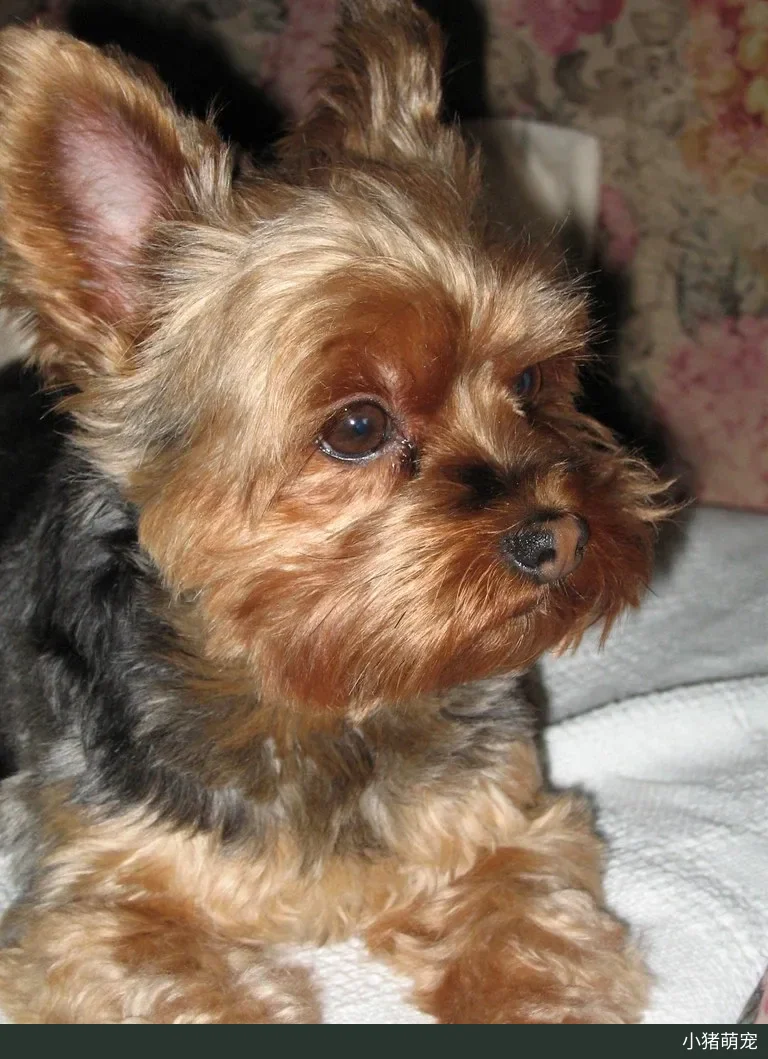
A Yorkshire Terrier clipped short; the golden-brown head, upright small ears, and dark back coat stand out. Photo: amber.itaylor; source: Flickr; license: CC BY 2.0.
The Yorkshire Terrier (Yorkie) comes from northern England. In the mid-nineteenth century it hunted rats in textile mills and mining districts of Yorkshire and Lancashire; later it became a Victorian lap pet. Under the AKC standard it weighs no more than 7 pounds (about 3.2 kg), yet it has a full terrier temperament. Keeping one means daily long-coat care, enough exercise, consistent positive training, and special attention to teeth and knees.
Origins and history
The Yorkie’s roots are really in Scotland. An AKC breed-history article explains that the Industrial Revolution reshaped the textile trade in the mid-nineteenth century; Scottish weavers moved south to Yorkshire for work and brought their terriers, including the silky-coated, blue-and-tan Clydesdale Terrier. Those dogs were crossed locally with Waterside Terriers (also called Otter Terriers), Old English Terriers, and other native dogs, and hunted rats in mills and in workers’ cramped lodgings. Early on they were shown as “Broken Haired Scotch Terriers” or “toy terriers”: AKC records a first appearance at a British dog show in 1861 as a broken-haired Scotch Terrier, with the Yorkshire Terrier name coming into use around 1870.
The dog treated as the breed’s foundation is “Huddersfield Ben,” born in Huddersfield in 1865. According to the AKC article he weighed about 11 pounds himself, yet his descendants settled at roughly half that weight; as a hugely popular stud, his bloodlines reach almost every Yorkie today. The breed later arrived in the United States; AKC recognized it in 1885. The FCI formally recognized the Yorkshire Terrier on 30 October 1954, with the United Kingdom as country of origin, placing it in Group 3 Terriers among toy terriers; the current valid standard was published on 8 September 2026.
Appearance and coat
What stands out most is the floor-length silky coat. The AKC standard describes a long-coated toy terrier: the coat is parted from the face and from the base of the skull to the tip of the tail, hanging straight down each side; the body is compact and well proportioned, the head carried high, the expression confident. The head is small and rather flat on top, the nose black, the eyes medium and dark, the ears small, V-shaped, and carried erect.
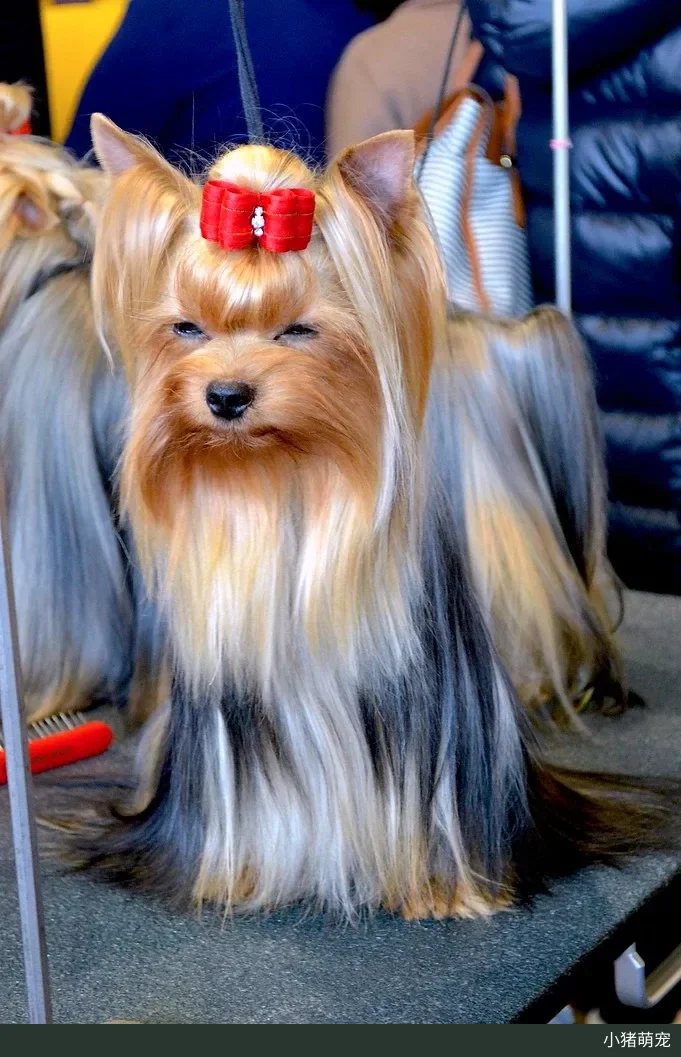
A Yorkshire Terrier in show-length coat sitting on a grooming table, topknot tied with a red bow; the golden-brown head contrasts with steel-blue long coat falling on both sides of the body. Photo: Petful.com; source: Flickr; license: CC BY 2.0.
Color is only one combination—blue and tan: the AKC breed page calls it “steel blue and rich golden tan,” and the standard specifies golden tan head furnishings and bright tan on the chest and legs. Under the AKC standard, solid or other colors, and any white chest patch longer than 1 inch, are disqualifications. On weight, AKC sets a maximum of 7 pounds; the FCI standard writes no more than 3.2 kg; the AKC breed page gives a height-at-shoulder reference of 7–8 inches (about 18–20 cm). Note that the standard describes the ideal show dog; pets are often larger: in a 2025 U.K. veterinary-records study, the median adult Yorkshire Terrier weight was 5.06 kg.
Temperament, exercise, and training
Do not be fooled by the small size. AKC describes the Yorkie as feisty, lively, and brave, sometimes a bit bossy, with the full set of terrier traits; the FCI standard calls temperament that of an “alert, intelligent toy terrier, with a spirited and even disposition.” It bonds closely with its owners and makes a capable little watchdog. The U.K. veterinary charity PDSA cautions that Yorkies can be quite stubborn and need patient training; their fine bones suit homes with older children better, so young children are less likely to injure them by accident.
Exercise need not be heavy, but it cannot be zero. AKC suggests two short walks a day plus occasional short bursts such as chasing a tennis ball; PDSA’s reference is about 30–40 minutes a day. Obedience, rally, agility, and similar dog sports work both body and mind. For training, AKC recommends enthusiastic praise and food rewards over harsh corrections, and gradual, calm, pleasant exposure from puppyhood to new places, people, and other dogs.
That long coat also means fixed grooming time. AKC advises daily brushing for long-coated Yorkies, with the topknot trimmed short or tied up so it does not irritate the eyes; bathing about once a week, and weekly checks of the ears for debris or signs of infection.
Common health concerns
Overall, Yorkshire Terriers are a healthy, long-lived breed. AKC gives an expected lifespan of 11–15 years. A 2025 study by the Royal Veterinary College (RVC) VetCompass team analyzed 28,032 Yorkies under primary veterinary care in the U.K. in 2016; among those that died, the median age was 13.56 years—more than a year and a half above the previously reported overall U.K. dog median (12.0 years). Longevity does not mean a life without problems, though.
Teeth are the top issue. The same study manually reviewed records for 3,308 Yorkies; the most common diagnosis was periodontal disease (21.10%), followed by overlong nails, anal-gland impaction, overweight or obesity, and retained deciduous teeth. The researchers therefore urge owners to keep up daily dental care such as brushing.
Knees and trachea also deserve attention. Patellar luxation (the kneecap slipping out of place) had a prevalence of 3.42% in that study; researchers saw predisposition to periodontal disease, retained deciduous teeth, and patellar luxation; AKC also advises limiting jump height for Yorkies, especially puppies, and the U.S. breed club’s recommended health checks include patella evaluation and eye exams. The Merck Veterinary Manual notes that tracheal collapse is seen mainly in toy and small dogs, with Yorkies accounting for about half to two-thirds of reported cases; the classic sign is a chronic dry, goose-honk cough that worsens in heat, excitement, and after exercise.
In addition, the Merck Veterinary Manual lists the Yorkie among toy breeds in which extrahepatic portosystemic shunts are more common. This congenital vascular anomaly lets some blood bypass the liver; signs usually appear in youth and are often neurological. PDSA also lists breed-related concerns including bladder stones, various eye diseases, and avascular necrosis of the femoral head (Legg-Perthes disease). “Predisposed” means relatively higher risk, not that every Yorkie will develop the condition. When choosing a puppy, ask about parental health-screening records; day to day, seek veterinary care promptly for coughing, abnormal gait, or changes in demeanor.
References
-
American Kennel Club. Yorkshire Terrier (Yorkie) Dog Breed Information. Accessed 2026-10-17.
-
American Kennel Club. Official Standard of the Yorkshire Terrier. Approved 2007-07-10, effective 2007-10-01.
-
Denise Flaim. Yorkshire Terrier History: From Working-Class to Luxury Lapdog. American Kennel Club, updated 2024-06-26.
-
Fédération Cynologique Internationale. YORKSHIRE TERRIER (86); FCI-Standard N° 86. Current valid standard published 2026-09-08.
-
O'Neill DG, Witkowska SD, Brodbelt DC, Church DB, Engdahl KS. Yorkshire Terriers under primary veterinary care in the UK – demography and disorders. Companion Animal Health and Genetics, 2025.
-
Tonozzi CC. Overview of Respiratory Diseases of Dogs and Cats. Merck Veterinary Manual, updated 2025-05.
-
Roberts JN. Congenital and Inherited Anomalies of the Liver in Animals. Merck Veterinary Manual, updated 2024-09.
-
PDSA. Yorkshire Terrier. Accessed 2026-10-17.