The Java sparrow (also called Java rice bird) is a small estrildid finch native to Indonesia’s Java and Bali; the scientific name commonly used is Lonchura oryzivora (synonym Padda oryzivora). Stocky and flock-loving, it is a familiar cage bird—yet wild populations in the native range are assessed as Endangered. This article outlines classification and conservation status, appearance and habits, housing and diet, plus health concerns and legal keeping points.
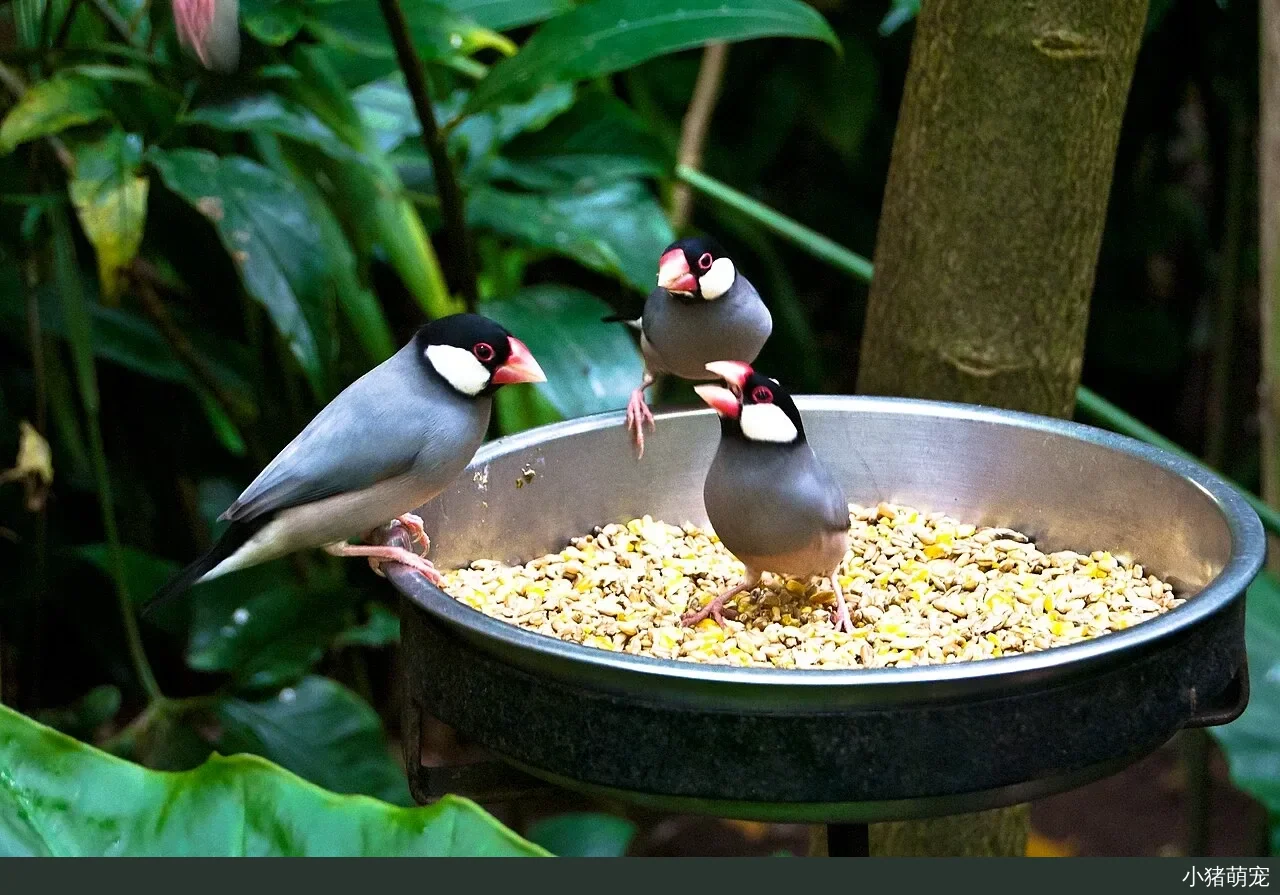
Three Java sparrows at Paignton Zoo, Devon, UK. Photo: Kirsty Andrews; source: Wikimedia Commons; license: CC BY 2.0.
Native range, appearance, and conservation status
The Java sparrow belongs to the order Passeriformes, family Estrildidae, and is among the larger species in that family. According to BirdLife, it is native to Indonesia’s Java and Bali, and possibly Madura; once widespread and common in the native range, numbers crashed in the late twentieth century, and it is now hard to find on Java. Long traded as a cage bird, it has been introduced widely—established populations exist in the Philippines, the United States (including Hawaii), Sri Lanka, Fiji, and elsewhere. Both Lonchura oryzivora and Padda oryzivora appear in the literature, reflecting different taxonomic treatments; either name works as a search term.
Wild-type plumage is strongly contrasted: black head, white cheeks, mainly slate-gray body, a thick pink bill, and a red eye-ring, with an overall stocky look. The Royal Veterinary Center care page records adults at about 15–17 cm from bill tip to tail tip and about 24–28 g. Males and females look nearly identical; mature males sing soft songs with clicks and bubbling notes, while females usually do not; for reliable sexing, only DNA testing is dependable. Captive breeding has produced several stable color varieties; the Avicultural Society of Australia lists normal gray, white, pied, and fawn.
In the native range, the outlook is poor. BirdLife DataZone rates the species Endangered, estimating about 1,000–2,499 mature individuals, with the population still declining and highly fragmented. The main threat is trapping for the cage-bird trade: Java sparrows flock and gather at roosts, so large numbers are easy to catch; one study estimated that about 38% of adult birds in central and eastern Java were taken each year in 2004 and 2005. The species is listed on CITES Appendix II, so international trade needs permits. BirdLife also notes that global trade is now mainly supplied by captive-bred birds, but the small native populations cannot sustain continued trapping.
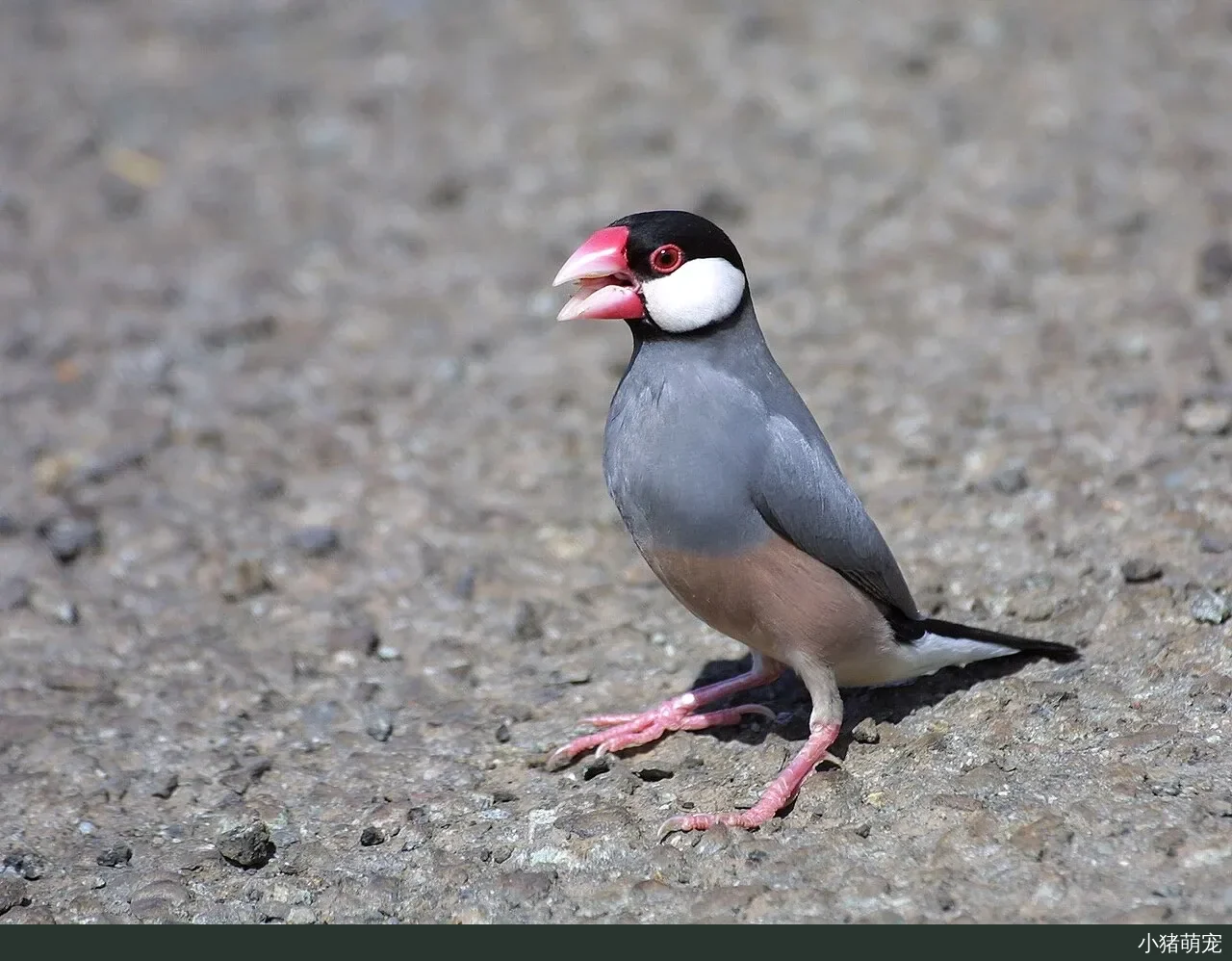
An adult Java sparrow on the University of Hawaiʻi at Mānoa campus—a free-living bird in an introduced range. Photo: Kim Bridges; source: Wikimedia Commons; license: CC BY 3.0.
Housing, diet, and daily life together
Java sparrows are strongly social; the Royal Veterinary Center advises against long-term single housing and recommends pairs or compatible same-species small groups. They are generally mild but may bully smaller finches and compete for nest sites in breeding season; the Avicultural Society of Australia likewise notes some aggression toward smaller birds, so mixed housing needs ample space and multiple feeding stations. They are not talking parrots; calls are mainly soft chirps, better suited to keepers who enjoy watching flock routines. They love bathing—a shallow dish of water each day meets that need. AVMA also reminds readers that most companion birds are not domesticated and are not suited to long periods of petting or perching on people.
Flight is their most important daily activity; horizontal flight distance matters more than cage height. The Royal Veterinary Center’s reference: absolute minimum for a pair is about 80 × 45 × 45 cm; pairs breeding or small groups are better in 120 × 60 × 60 cm or larger, and indoor/outdoor aviaries are ideal; bar spacing about 1 cm or less. Offer natural wood perches of varying thickness at opposite ends so birds must fly between them; also provide cuttlebone or a mineral block for calcium. Line the tray with paper or aspen-type bedding; spot-clean daily and change fully weekly; skip cedar shavings. Keep the cage off the floor, away from drafts, kitchen fumes, and aerosols. Based on Victoria cage-bird keeping rules, the Avicultural Society of Australia’s area reference is: aviary about 5,000 cm² for the first bird plus about 2,400 cm² per additional bird (height at least 60 cm); cage about 1,300 cm² for the first bird plus about 650 cm² per additional bird (height at least 34 cm). These are specific institutional or regional reference figures, not a worldwide legal standard. AVMA also suggests cages that make food bowls and droppings easy to remove, and ample out-of-cage time when supervised.
A quality finch seed mix—mainly white, yellow, and red millet and canary seed—works as a staple; Java sparrows especially like paddy rice in the husk, offered in moderation. Several times a week add soaked or sprouted seed; in molt and breeding season add soft foods such as egg food daily; rotate greens such as dandelion, chicory, chickweed, and seeding grass heads. Keep cuttlebone and grit available; keep drinking water clean and fresh. Caged birds fatten easily—limit high-oil seeds such as hemp and sunflower outside breeding season. Avoid entirely: avocado, chocolate, caffeinated drinks, alcohol, salt, onion, garlic, apple and pear seeds, stone-fruit pits, and moldy or spoiled seed. AVMA also notes that seed- and nut-heavy diets are unbalanced; switch diets gradually and ask an avian veterinarian for a concrete plan.
Java sparrows do not need reptile-style basking spots or UVB lamps. The Royal Veterinary Center suggests a stable room temperature around 18–24 °C; once fully acclimated they may tolerate cooler conditions around 10–15 °C, but should not go below about 10 °C, and should avoid frost, sudden temperature swings, and cold wind. Humidity should be moderate (about 40%–60%); chronically damp, stagnant air encourages mold and mites. Provide about 10–12 hours of light daily and a truly dark rest period at night. In hot, humid summers keep cages out of direct sun and stuffy closed rooms; keep air moving and supply enough drinking and bathing water.
Health concerns and legal and ethical reminders
The following is a popular overview only and does not replace veterinary care. Problems listed on the Royal Veterinary Center care page include air-sac mites, obesity and fatty liver, scaly face and scaly leg mites, egg binding (dystocia) in hens, respiratory and fungal infections, and intestinal parasites. Seek an avian veterinarian promptly if a bird open-mouth breathes, pumps the tail with each breath, makes clicking sounds while breathing, sits fluffed with eyes closed on the cage floor for long periods, stops eating or drinking or loses clear weight, has watery, discolored, or bloody droppings, a hen strains repeatedly with swelling near the cloaca, or cannot perch steadily. AVMA advises quarantining new birds from existing birds; quarantine length and exam plans follow a licensed veterinarian. This site does not give drug or dosage advice.
Java sparrows are Endangered in the native range, internationally trade-controlled under CITES, and in some introduced ranges treated as invasive or rice-field pests, with keeping or import banned or restricted—so legality varies by place; check current local rules before keeping. Buy captive-bred birds with clear, legal provenance; do not buy birds of unknown origin or suspected wild-caught stock. Cross-border or interprovincial purchases must follow plant and animal quarantine plus CITES and wildlife-protection rules as required by the competent authorities where you live. Java sparrows have become established invasives in places such as Hawaii—never release cage birds. Lifespan is not short: care pages record captive birds often living 5–10 years, occasionally 12–15 with good care; individual variation is large, so assess whether you can provide long-term care before deciding.
Cage sizes, temperature ranges, and color lists cited here come from specific institutional pages and may change by region and edition; BirdLife and IUCN numbers estimate the native range and exclude introduced populations. For actual keeping, follow the latest cited pages, local law, and a licensed veterinarian.
References
-
Avicultural Society of Australia – Fact Sheet: Java Sparrows
-
Piggy Pets · Welcome to my pet planet