The Chinese water dragon (Physignathus cocincinus)—also known as the Asian or Thai water dragon—is a vivid green agamid lizard crowned by a serrated dorsal crest and balanced by a long banded tail [1][6]. In captive exhibits and pet settings, however, this energetic lizard suffers from a notoriously common injury: repeatedly lunging into clear glass walls or rubbing its nose raw along transparent panels until the snout becomes ulcerated or deformed [6][7][8]. Understanding why water dragons strike glass starts with their wild riparian-forest escape instincts, and also requires recognizing their current legal status as National Class II Protected Wildlife in China and a CITES Appendix II species globally [2][3][4].
An Arboreal and Semi-Aquatic Riparian Specialist
According to The Reptile Database and the IUCN Red List, Physignathus cocincinus is native to closed-canopy, lowland riparian forests from sea level up to about 770 m across Vietnam, Laos, Cambodia, eastern and southeastern Thailand, and southern China—specifically southwestern Guangdong, Guangxi, and Hekou in Yunnan, where its Chinese area of occupancy is thought to fall below 500 km² [1][2]. Adults can grow to roughly 90 cm in total length, with more than half consisting of a laterally compressed swimming tail [6]. Bright green skin marked with pale diagonal stripes blends seamlessly into sunlit canopy foliage directly above forest streams and pools [2][6].

Figure: Wild Chinese water dragon clinging vertically among sunlit riparian branches with its green camouflage and dorsal crest. Mark Bolnik, Wikimedia Commons

In the wild, Chinese water dragons are diurnal, alert, insectivorous-leaning omnivores that hunt invertebrates, small vertebrates, and occasional plant matter while climbing vertically through streamside vegetation [6][7]. Water is central to both thermoregulation and defense: perched on overhanging limbs above flowing creeks, a startled lizard does not freeze quietly—it launches explosively downward into the stream and swims underwater to vanish beneath roots or banks [2][6]. That high-speed flight reflex works brilliantly in open riparian forest, yet turns destructive inside a rigid glass box [6][7].

Figure: Chinese water dragon perched on a wet boulder amid a flowing stream illustrating its semi-aquatic habitat. Warren Garst, Wikimedia Commons

Why Chinese Water Dragons Repeatedly Strike Glass
Chronic glass striking stems from a collision between reptile visual perception, startle physiology, and transparent caging. First, water dragons do not interpret clear glass as an impassable solid barrier. In natural forests, an unobstructed visual line leads through open air to foliage or water; when a lizard sees a room, hallway, or houseplant through clear panes, it repeatedly sprints forward or paces while pressing its snout against the glass to reach the space beyond [6][7]. The Merck Veterinary Manual similarly cautions that while owners favor glass aquariums for viewing, full visibility exposes reptiles to constant external motion and chronic stress [7].
Second, explosive startle responses amplify ordinary disturbances into hard nose impacts. Footsteps outside the tank, overhead reaching, reflections perceived as rival lizards, or pressure from a dominant cagemate trigger an immediate bolt for cover or water; inside a cramped glass tank, the lizard slams headfirst into the pane within a single stride [6][7]. Merck's clinical examination guidelines explicitly instruct veterinarians to inspect the rostrum for trauma caused by repeated escape attempts from poorly designed vivaria or evasion of dominant cagemates [7].
Third, repeated friction quickly progresses from superficial scale wear to severe oral pathology. Clinically termed rostral abrasion, the earliest stage shows mild redness or crusting along the tip of the upper and lower jaws; as the BSAVA Manual of Reptiles notes, correcting enclosure design immediately at this mild stage can sometimes stop further progression [8]. Left unresolved in a humid enclosure, however, raw tissue rapidly develops secondary bacterial infection, ulcerative stomatitis (mouth rot), gingival recession, tooth loss, head abscesses, and destructive erosion of the maxillary and mandibular bone [6][8].
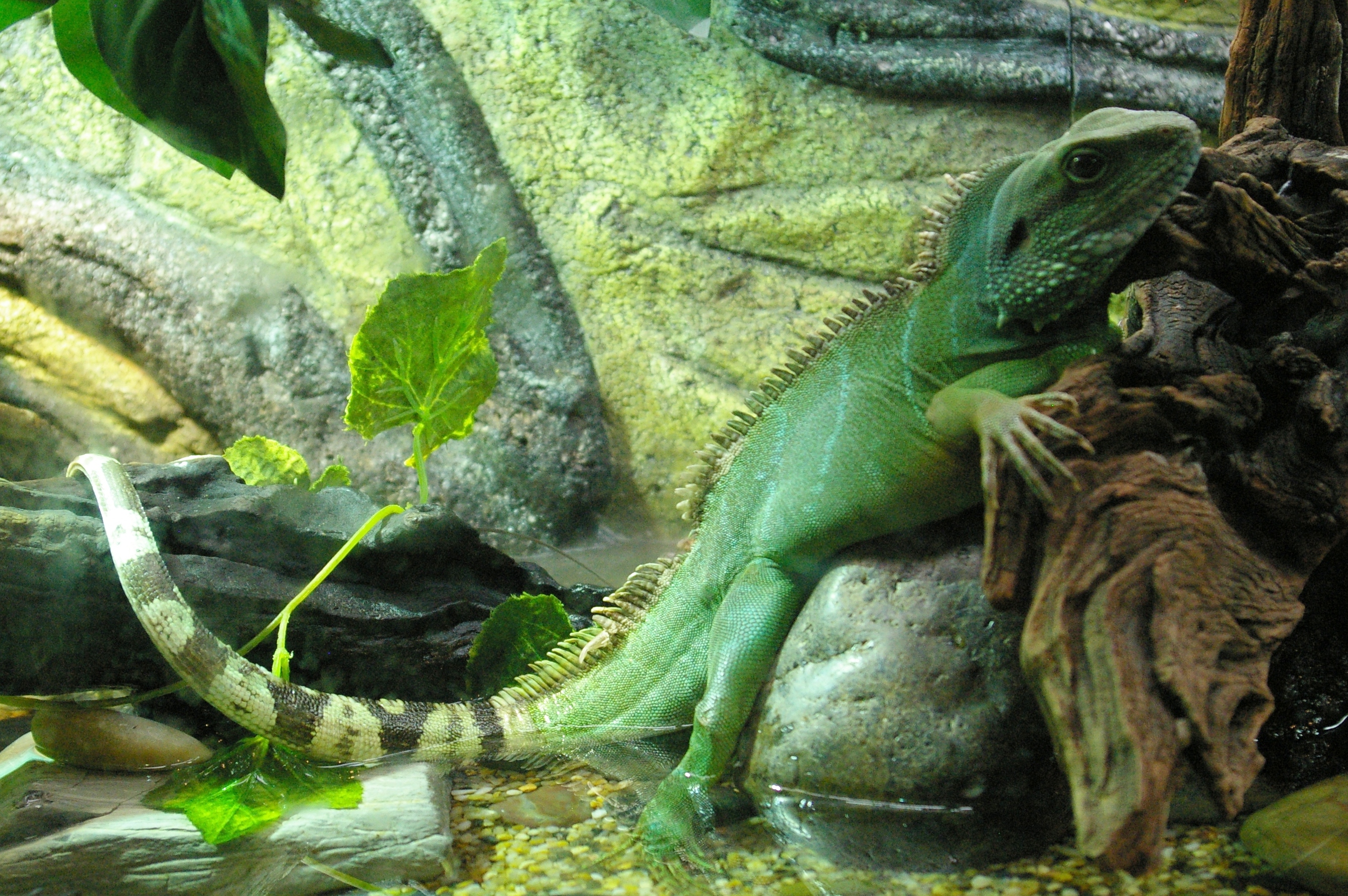
Figure: Adult Chinese water dragon showing an intact healthy snout inside an enclosure with opaque backdrop driftwood and water. Jakub Hałun, Wikimedia Commons

Vertical Enclosure Needs and Legal Protection Boundaries
Where captive-bred individuals are lawfully maintained in accredited institutions or permitted jurisdictions, preventing snout trauma depends on abandoning standard glass aquariums for tall, mostly opaque vertical enclosures [6][7]. Reptile veterinarian Stephen J. Divers (2002) recommends at least 2 m high by 1.8 m long by 1 m deep for one to three adults, built from sealed melamine wood, plastic, or fiberglass rather than all-glass panels, using dark visual barriers or one-way glass on viewing windows so the lizard recognizes solid walls [6]. The Merck Veterinary Manual sets a minimum of 0.4 m³ per 10 cm of total length for arboreal lizards and lists water dragons at a daytime thermal gradient of 24 to 30 °C (with basking about 5 °C warmer and a 5 °C nighttime drop), 80 to 90 percent humidity supported by a large bathing pool and misting or drip systems, mandatory UVB (290–300 nm) lighting, and robust ventilation—explicitly warning against restricting airflow to trap humidity, which precipitates skin and respiratory disease [6][7].
Veterinary intervention boundaries are equally clear. Mild rubbing demands immediate visual shielding, calmer placement, and verification of space, perches, and humidity; any bleeding, ulceration, thick scabs, lip swelling, oral discharge, refusal to eat, weakness, or jaw deformity requires evaluation by a reptile veterinarian to inspect internal mouth involvement, perform debridement under anesthesia if needed, and prescribe targeted antimicrobial therapy rather than attempting home treatment [7][8].

Figure: Wild Chinese water dragon sleeping horizontally on a slender forest branch displaying its clean pointed snout. Wich'yanan L, Wikimedia Commons

Finally, readers must rely on current legal and conservation classifications rather than outdated care sheets. Because of heavy harvesting for food and international pet markets alongside riparian forest clearance, the IUCN Red List (2019) classifies Physignathus cocincinus as Vulnerable (criteria A4cd), and the species entered CITES Appendix II on February 23, 2023 [2][3]. Crucially, in mainland China, the current 2021 List of National Key Protected Wild Animals designates Physignathus cocincinus as National Class II Protected Wildlife under forestry and grassland jurisdiction with no 'wild populations only' exemption, meaning unauthorized private purchase, breeding, or keeping violates China's revised Wildlife Protection Law [4][5]. Even in regions where documented captive-bred animals remain legal, wild-caught imports should never be purchased, only keepers capable of building room-scale humid vertical vivaria with filtered water basins and exotic veterinary support should consider them, and captive dragons must never be released outdoors—where escaped pets have already established introduced populations in Taiwan and Hong Kong [1][2][6].
References
[1] The Reptile Database. Physignathus cocincinus CUVIER, 1829. https://reptile-database.reptarium.cz/species?genus=Physignathus&species=cocincinus
[2] Stuart, B. L., Sumontha, M., Cota, M., Panitvong, N., Nguyen, T. Q., Chan-Ard, T., Neang, T., Rao, D.-Q., & Yang, J. (2019). Physignathus cocincinus. The IUCN Red List of Threatened Species 2019: e.T104677699A104677832. https://www.iucnredlist.org/species/104677699/104677832
[3] I-CITES Taxon Profile: Physignathus cocincinus (CITES Appendix II listing effective February 23, 2023). https://cites.application.developpement-durable.gouv.fr/viewtaxon.do?id=27250
[4] National Forestry and Grassland Administration & Ministry of Agriculture and Rural Affairs of China. List of National Key Protected Wild Animals (2021 Revision, Notice No. 3 of 2021). https://wjorg.com/fagui/国家重点保护野生动物名录-2021年调整/
[5] Standing Committee of the National People's Congress. Wildlife Protection Law of the People's Republic of China (Revised Dec. 30, 2022; effective May 1, 2023). http://www.npc.gov.cn/npc/c2/c30834/202212/t20221230_321016.html
[6] Divers, S. J. (2002). Care of the Thai water dragon, Physignathus cocincinus. Journal of Herpetological Medicine and Surgery, 12(2): 45. https://doi.org/10.5818/1529-9651.12.2.45
[7] Divers, S. J., & Comolli, J. R. Management and Husbandry of Reptiles; Clinical Procedures for Reptiles. Merck Veterinary Manual (updated Jul 2026). https://www.merckvetmanual.com/exotic-and-laboratory-animals/reptiles/management-and-husbandry-of-reptiles
[8] Brown, S. J. L., Naylor, A. D., Machin, R. A., & Pellett, S. (2019). Gastrointestinal system. In BSAVA Manual of Reptiles (pp. 284–308). British Small Animal Veterinary Association. https://www.bsavalibrary.com/content/chapter/10.22233/9781905319794.chap17