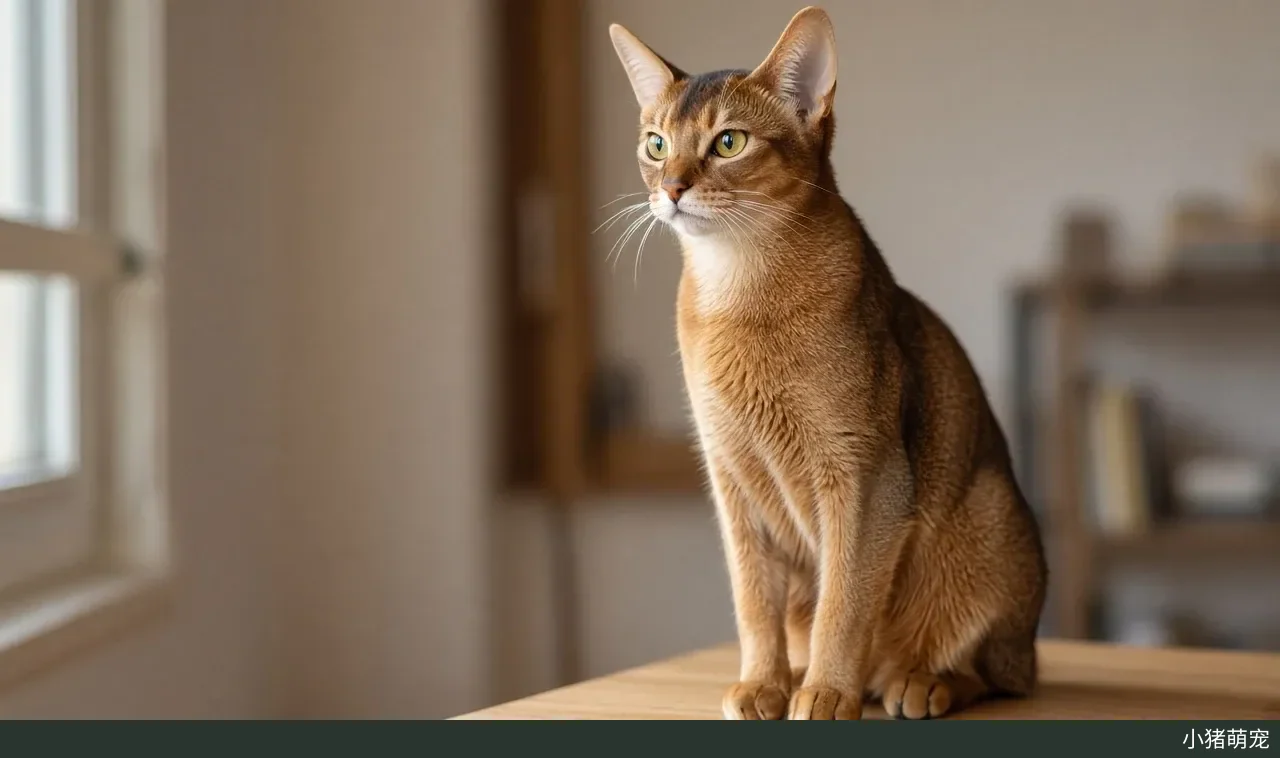
A ruddy Abyssinian by a window, showing large ears, almond eyes with dark “eyeliner,” and a ticked coat. AI-generated illustration, not a real photograph.
The Abyssinian (often nicknamed Aby) is widely regarded as one of the oldest cat breeds, already shown at London’s Crystal Palace cat show in 1871. Each hair carries alternating light and dark bands, giving a miniature wildcat look; temperament is bright, curious, and energetic—they love high perches but rarely settle long on a lap. Drawing on CFA, TICA, and FIFe breed materials and veterinary genetics research, this article covers origin, appearance, temperament, common hereditary diseases, and care essentials.
Origin and history
“Abyssinia” is an old name for Ethiopia, but the name does not mean the breed comes from Africa. CFA explains that it only reflects that the earliest cats shown in Britain were brought back from Ethiopia. The first recorded individual was Zula, at the Crystal Palace show in London in 1871. TICA adds a widely told story: after the Abyssinian War ended in 1868, British soldiers brought Zula to Britain. It also cautions that no documents yet link Zula directly to today’s Abyssinian.
Because they resemble cats in ancient Egyptian murals and statues, they are often romantically called descendants of sacred Egyptian cats—but that is appearance-based association only. A 2008 Genomics study used microsatellite markers to compare 22 breeds and random-bred cats worldwide. Forty Abyssinian samples carried markers of both Southeast Asian and Western breeds and, on the analysis plot, fell with Sri Lankan cats between Eastern and Western clusters. Researchers inferred that founding the breed involved cats from both Asia and Europe. TICA’s wording is that recent genetic work treats cats along India’s Bay of Bengal coast as possible ancestors. Note that such population genetics offers clues; the breed’s exact origins remain unsettled.
The breed was mainly developed and refined in Britain. Abyssinians reached the United States in the early twentieth century, were among CFA’s earliest registered breeds in 1906, first shown in the U.S. in 1909, and were systematically bred in America from the 1930s. Europe’s FIFe recognized the breed in 1949. A footnote: per TICA, the first domestic-cat genome sequenced in 2007 came from an Abyssinian named Cinnamon.
Appearance and coat colors
The Abyssinian is a medium-sized shorthair. CFA’s standard describes a lithe, flexible, solid body between cobby and elongated extremes; legs are fine, and stance looks almost tip-toe. The head is a modified wedge with rounded contours; ears are large, broad at the base and slightly cupped; large almond eyes have a dark “eyeliner” rim. On weight, TICA lists adult females about 6–9 lb (about 2.7–4.1 kg) and males about 7–12 lb (about 3.2–5.4 kg), noting they look slim yet feel surprisingly heavy when held (another range on the same page is slightly narrower).
Most distinctive is the ticked coat—agouti ticking: each hair has alternating light and dark bands, giving the coat a flowing sheen. CFA and FIFe standards call for 2–3 bands per hair; TICA writes 4–6 alternating bands—the former counts dark bands, the latter total light and dark bands, roughly the same visual effect. FIFe also notes ticking develops slowly; full adult coat may take until about age 2, so kittens and young cats looking less “finished” is normal.
Recognized colors differ by association. CFA accepts only four: ruddy (warm ruddy ground with black ticking—CFA’s most popular), cinnamon, blue, and fawn; FIFe recognizes ruddy, blue, sorrel, fawn, and their silver versions; TICA splits traditional and silver groups and additionally includes chocolate and lilac. CFA cinnamon and FIFe sorrel describe similar warm copper-red grounds with chocolate-brown ticking. Eye color: CFA gold or green; FIFe amber, green, or yellow. Both standards allow only limited white on the chin and around the nostrils (CFA also includes the upper throat).
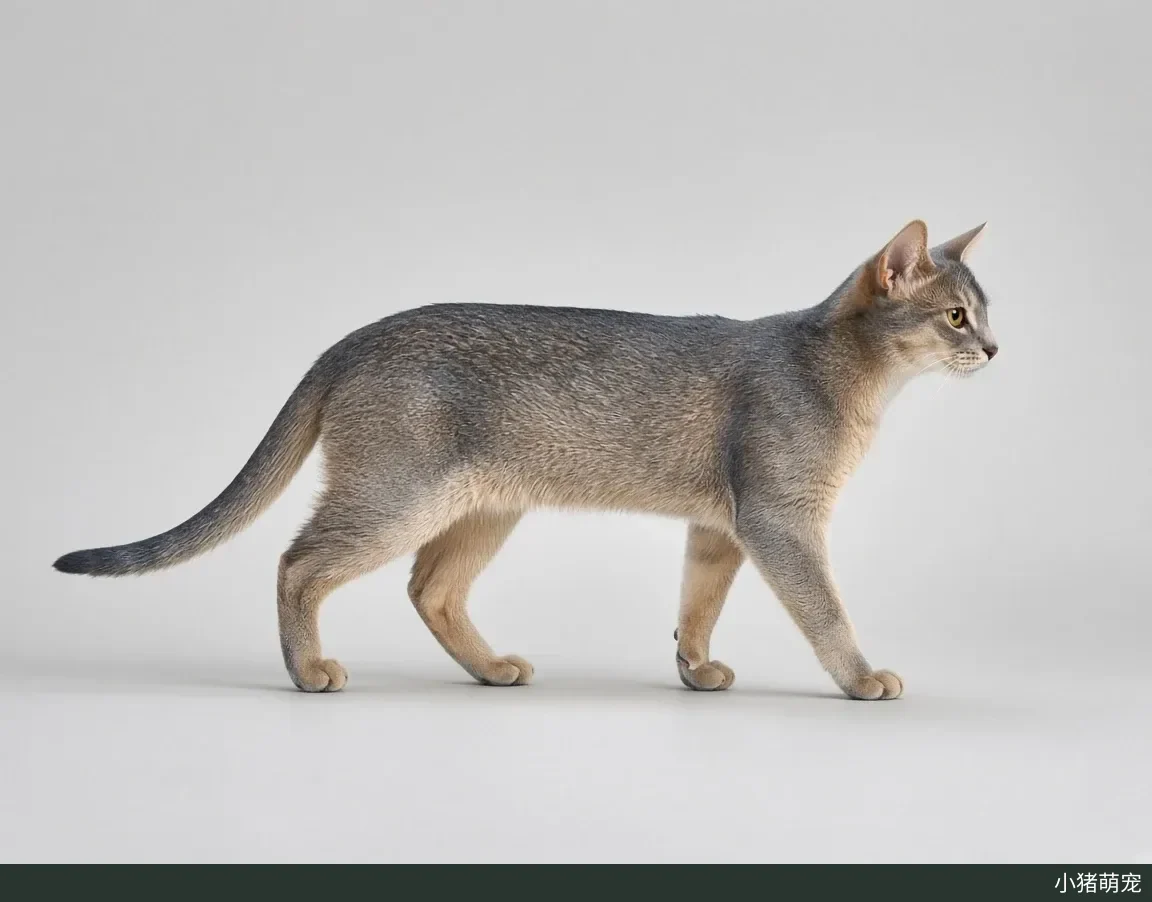
A blue Abyssinian in profile, showing a lithe build, slender limbs, and coloring that deepens along the spine with a darker tail tip. AI-generated illustration, not a real photograph.
Temperament and living together
CFA summarizes them as “busy, active, opinionated, and people-oriented.” Abyssinians are smart and intensely curious, personally inspecting every corner of the home, and rarely still when awake; if toys run short, they invent their own. They love their people but are so active they often leave a lap after a short sit; when they want attention they may reach out a paw for a gentle tap. They are not especially vocal, yet are skilled at making wants clear.
They prefer high spots with a view of the whole room. TICA jokes: if a cat on a ceiling fan would undo you, this breed may not suit you. TICA also says they are often called “dogs of the cat world,” usually get along well with children, dogs, and other cats, and many keep kittenish playfulness for life. CFA finds their energy a good match for children who enjoy hunting games; well-socialized individuals adapt to change, and some even enjoy harness walks outdoors.
Note that CFA says Abyssinians dislike long stretches alone—if the home is quiet by day, consider keeping two—while TICA also cautions they may not thrive in multi-cat homes where attention must be shared with a large group. These are breed-association portraits of the type overall; for any individual cat, socialization history and personality matter as much.
Health and care essentials
To be clear: Abyssinians are not among breeds whose defining look itself (folded ears, short legs, flat faces) drives health controversy. CFA’s standard keeps type between cobby and elongated extremes; FIFe lists Siamese-type or round heads as faults that bar certificates—neither encourages extremes. Health focus is several hereditary diseases. TICA’s overall view is “generally healthy,” lifespan 14–17+ years, but lists several higher-risk conditions.
Pyruvate kinase deficiency (PK-Def) is an inherited hemolytic anemia, autosomal recessive: a cat must inherit a mutant copy from each parent to be affected; carriers with one copy are healthy but can pass the mutation on. Severity varies widely. Kohn et al. (2008) followed 25 affected Abyssinians and Somalis: 11 owners noticed no signs; 14 had lethargy, diarrhea, pale mucous membranes, poor appetite, and similar; six died or were euthanized between 1.3 and 11.3 years, with the disease suspected as related. Because animals may be asymptomatic, 16 of 25 had already been used for breeding before diagnosis. Of 502 test results collected in the same study, 7.4% were affected and 23.3% carriers—but these were samples European breeders submitted in 2002–2006, not today’s overall rates. CFA notes breeders can now use genetic testing to keep carriers out of breeding programs.
Progressive retinal atrophy (PRA) gradually destroys retinal photoreceptors and leads to blindness. UC Davis Veterinary Genetics Laboratory explains that the rdAc form in Abyssinians is caused by a CEP290 mutation: vision is normal at birth; degeneration is detectable by electroretinogram at about 7 months; most go blind by 3–5 years, with no treatment. It is also recessive; two carriers mating yield about 25% affected kittens. Abyssinians also have a rod–cone dysplasia (Rdy) caused by CRX mutations.
Renal amyloidosis (RA) is amyloid deposition in the kidneys that can progress to kidney failure. A familial form occurs in Abyssinians; a 2021 Scientific Reports multi-omics study concluded it is not a simple single-gene disease, and triggers remain unclear; TICA also notes there is no DNA test for it. TICA lists patellar luxation (kneecap slipping out of place) among risks; CFA mentions gingivitis and other oral issues, and some breeders teach new owners tooth brushing as prevention.
In daily practice:
- Before bringing a cat home: TICA advises asking breeders for PK-Def and PRA genetic test proof; renal amyloidosis currently has no DNA test.
- Space to climb: Provide cat trees and high perches; window spots with bird views are favorites; schedule interactive and hunting-style play daily, with enough toys to “work.”
- Companionship: Avoid long solo hours; in multi-cat homes, watch whether attention is shared fairly.
- Grooming: CFA suggests brushing a few times a month to control shedding; a chamois wipe adds sheen; bathing is usually unnecessary.
- Nails and teeth: TICA suggests trimming nails every two weeks and brushing from a young age with vet-approved pet toothpaste.
- Water: Refresh clean water daily; place bowls at least 3 feet (about 0.9 m) from food; circulating fountains (stainless steel preferred) also work—TICA’s general advice for all cats.
- Watch for change: Lethargy, pale gums or mucous membranes, or clear vision loss warrant prompt veterinary care.
References
-
The Cat Fanciers' Association. Abyssinian (breed profile and standard). Accessed 2026-10-17.
-
The International Cat Association. Abyssinian. Accessed 2026-10-17.
-
Fédération Internationale Féline. Abyssinian / Somali breed standard (2026-01-01 edition).
-
Lipinski MJ, Froenicke L, Baysac KC, et al. The ascent of cat breeds: Genetic evaluations of breeds and worldwide random-bred populations. Genomics. 2008;91(1):12–21.
-
Kohn B, Fumi C. Clinical course of pyruvate kinase deficiency in Abyssinian and Somali cats. Journal of Feline Medicine and Surgery. 2008;10(2):145–153.
-
UC Davis Veterinary Genetics Laboratory. Progressive Retinal Atrophy (PRA rdAc) (Abyssinian). Accessed 2026-10-17.
-
Genova F, Nonnis S, Maffioli E, et al. Multi-omic analyses in Abyssinian cats with primary renal amyloid deposits. Scientific Reports. 2021.