If you know the Siamese, you may recognize the face of a Balinese before the cat turns and you catch sight of its tail. The two breeds are related, which helps explain the familiar description “longhaired Siamese.” The World Cat Federation (WCF) titles its standard Balinese/Foreign White Longhair, gives it the code BAL and lists the Siamese among the permitted outcrosses. To picture the cat described in that standard, look at where the hair grows long and how much of the outline beneath it you can still see. [1][3]
Start with a side view. The WCF describes a medium-sized, lithe, muscular cat whose shoulders and rib cage are no wider than its hips. Long, slender legs end in small oval paws. The glossy, medium-length coat has no undercoat and lies close enough to the flanks that you can follow the line from shoulder to hip. The tail itself is slender and tapers to a fine tip, but its longer hairs spread into a plume. In the photograph below, the dark plume fans out behind the walking cat while the pale coat follows the curve of its body. [1][2]
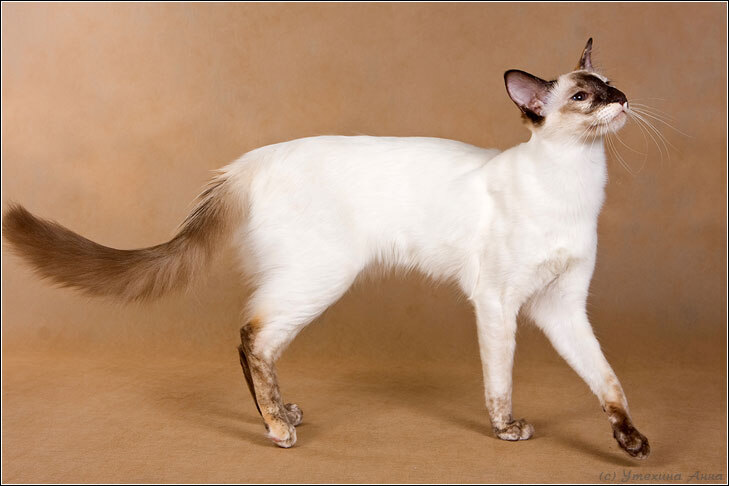
Figure: The tail plume in motion. Фотограф: Анна Утехина, Wikimedia Commons[6]

Seen from the front, the head forms a wedge. Imagine drawing a line from the tip of the nose along each side of the face. The muzzle is fine, the nose long and straight, and the outer edges of the large, broad-based ears continue those lines. The blue, almond-shaped eyes sit at a slight slant. On a pointed cat, the face, ears, feet and tail carry deeper color than the torso. Points develop gradually and reach their full expression in adulthood. On a young kitten, the proportions of the head and the texture of the coat can be easier to appreciate than the depth of the facial color. [1][2]
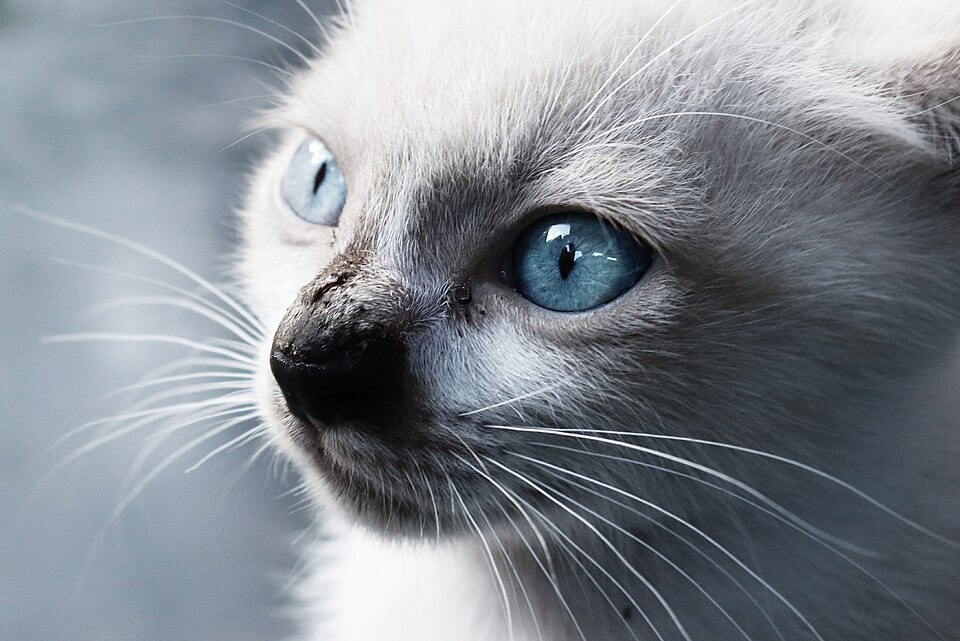
Figure: Blue eyes and facial points. Pomewgranate, Wikimedia Commons[7]

Registry names can also tell you something about color. The WCF recognizes a range of point colors, including tabby points, and calls the solid white longhair a Foreign White Longhair. The Cat Fanciers’ Association (CFA) uses two color divisions within its Balinese breed. Seal, chocolate, blue and lilac points belong to the Balinese division. Red points and striped points, called lynx points, are among those in the Javanese division. That explains why a striped, pointed longhair may appear as Javanese in a CFA listing. For grooming purposes, both divisions have the same close-lying, silky coat. [1][2]
The Governing Council of the Cat Fancy recommends a wide-toothed comb to lift out loose hair. Choose one with smooth tips and start when the cat is content to stay beside you. Follow the direction of growth from the shoulders down the sides, using a light stroke. Once the teeth pass freely and the loose hairs come away, move on. For the plume, support a small section of hair in your hand and begin near the ends. If the comb catches, take a smaller section and shorten the stroke so the teeth can ease through without tugging at the skin. Let the tail hair fall back into place. [1][3]
Breed descriptions often portray the Balinese as active and interested in whatever people are doing. When preparing a room, trace a route the cat could actually use. Can it step up to a stable perch, turn around there and get down easily? A perch near a favorite family chair gives it the choice of watching or coming closer. A quiet, sheltered resting place gives it somewhere to withdraw. Security, opportunities for activity and predictable contact with people are needs the Feline Veterinary Medical Association identifies for indoor cats generally. Where your own cat likes to pause or settle can guide the arrangement. [3][4]
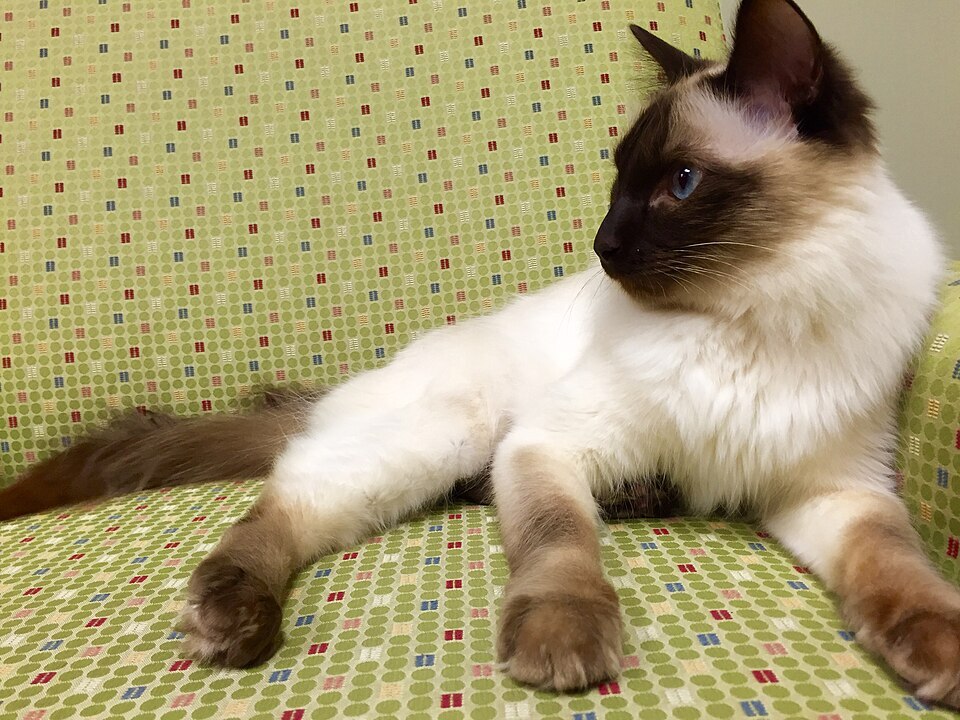
Figure: Body coat and tail plume at rest. Talophex, Wikimedia Commons[8]

Leave a stretch of floor clear for stalking and pouncing. Draw a wand toy away from the cat, pause it at the edge of cover so the cat can watch and approach, then let the cat catch it. A sociable cat may also be quite happy to follow the action from a chair. In a home with several cats, consider each animal’s route to water, the litter box and a resting place. If one cat can block all access by sitting in a doorway, a second bowl in the same corner does little good. Put resources in separate places that each cat can reach. [3][4]
One screening test worth asking a breeder about by name is rdAc progressive retinal atrophy. The UC Davis Veterinary Genetics Laboratory lists the Balinese among the breeds appropriate for this test. It detects a particular variant of the CEP290 gene associated with a recessively inherited form of retinal degeneration. An affected kitten can have normal vision at birth and lose retinal function over time. Blue eye color and the ability to track a toy tell you little about whether a kitten inherited the variant. Ask which cat was tested, whether the report specifies rdAc and how many copies it found. [1][5]
On the report, N/N means the test found no copies of this variant. N/rdAc means the cat carries one copy, and rdAc/rdAc means it has two and is affected by this form of the disease. Check whose name is on the report. A parent’s result helps explain what a kitten could inherit, while the kitten’s own test gives its genotype directly. At home, pay attention to changes on familiar routes. If your cat repeatedly hesitates or bumps into things in a dim hallway it once crossed easily, note the location and lighting. Bring those observations and any genetic report to your veterinarian for an eye examination. [5]
References
-
[1] World Cat Federation. Balinese/Foreign White Longhair (BAL). Updated January 1, 2023.
-
[2] The Cat Fanciers’ Association. Balinese.
-
[3] The Governing Council of the Cat Fancy. Balinese.
-
[4] Feline Veterinary Medical Association. New Feline Veterinary Medical Association Position Statement Reimagines Life for Indoor Cats. August 28, 2025.
-
[5] UC Davis Veterinary Genetics Laboratory. Progressive Retinal Atrophy (PRA rdAc) (Abyssinian).