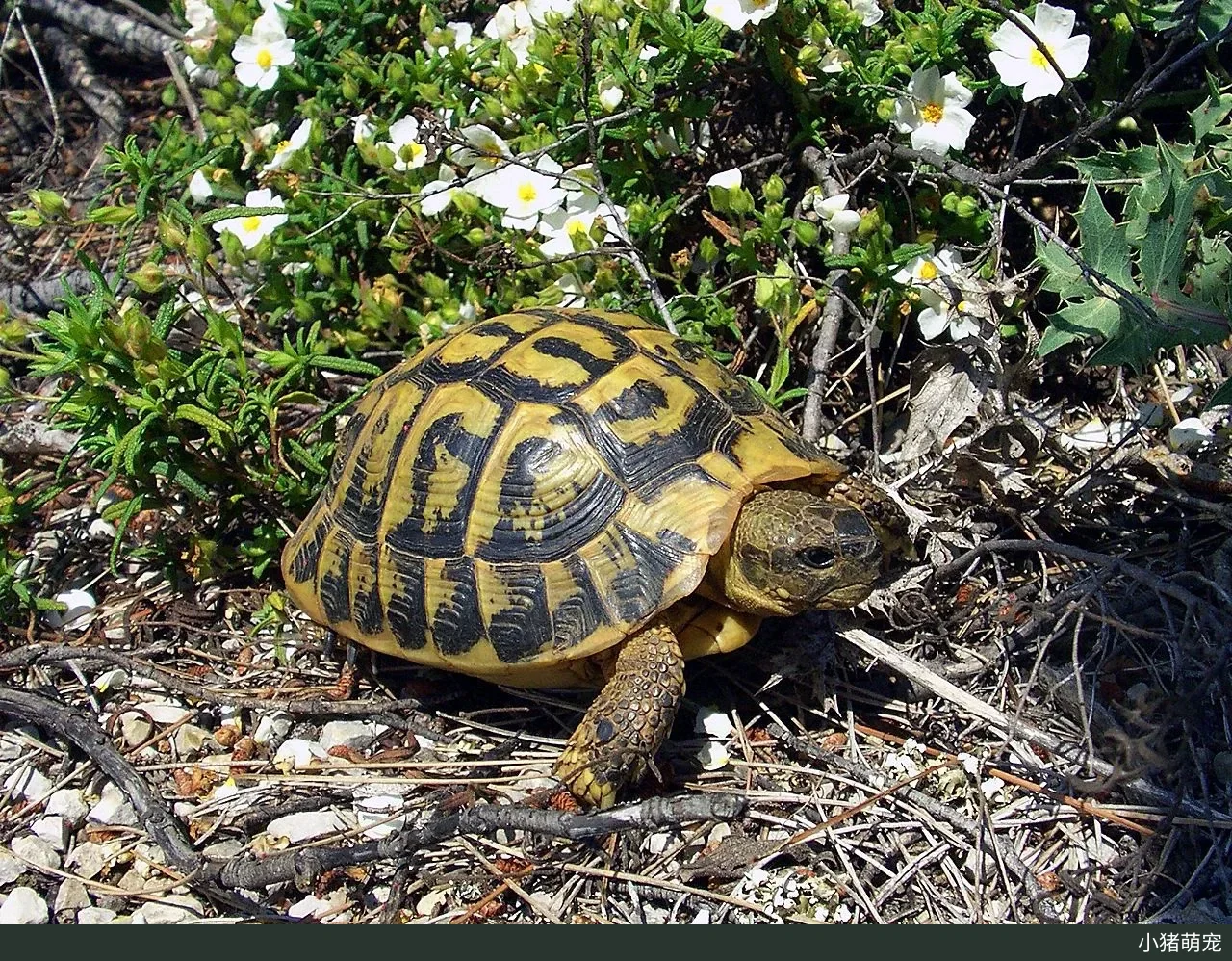
A Hermann's tortoise crawling beside scrub on Mallorca, Spain, with clear yellow-and-black patterning on its high-domed shell. Photo: Orchi; source: Wikimedia Commons; license: CC BY-SA 3.0.

Hermann's tortoise (Testudo hermanni) is a medium-sized tortoise from the Mediterranean coasts of southern Europe. Adult carapace length averages about 13–18 cm, and with good care it can live with an owner for decades. It needs ample sun and UVB and a high-fiber diet based on wild greens; in China it is also managed as a national Category II protected wild animal. Drawing on veterinary, specialist husbandry, and conservation sources, this article outlines its habits, care, health, and legality.
Natural habits
Hermann's tortoises range across the European Mediterranean: the west is patchy along Spain's northeastern coast, southern France, and much of Italy, plus the Balearics, Corsica, Sardinia, Sicily, and other islands; the east is more continuous across the Balkans into European Turkey. Two subspecies are usually recognized—western T. h. hermanni and eastern T. h. boettgeri—roughly divided by the Po Plain in northeastern Italy; some sources also treat populations in Bosnia and Herzegovina and Croatia as T. h. hercegovinensis. Typical habitat is sunny, rocky slopes with low, sparse vegetation and semi-open scrub mixed with grassland. Some eastern populations reach about 1,300 m elevation, but most live below 500 m.
Carapace length averages about 130–180 mm; females average about 12% larger than males. Unlike most tortoises, Hermann's has a horny, claw-like scale at the tip of the tail—more developed in males, a small identification clue. Wild females usually lay 1–2 clutches a year, at most 3; western subspecies average about 3.3 eggs per clutch, eastern about 4.3. Estimated annual adult survival is 85%–97%. Wild animals typically hibernate from October–November through March–April, often for 4–5 months.
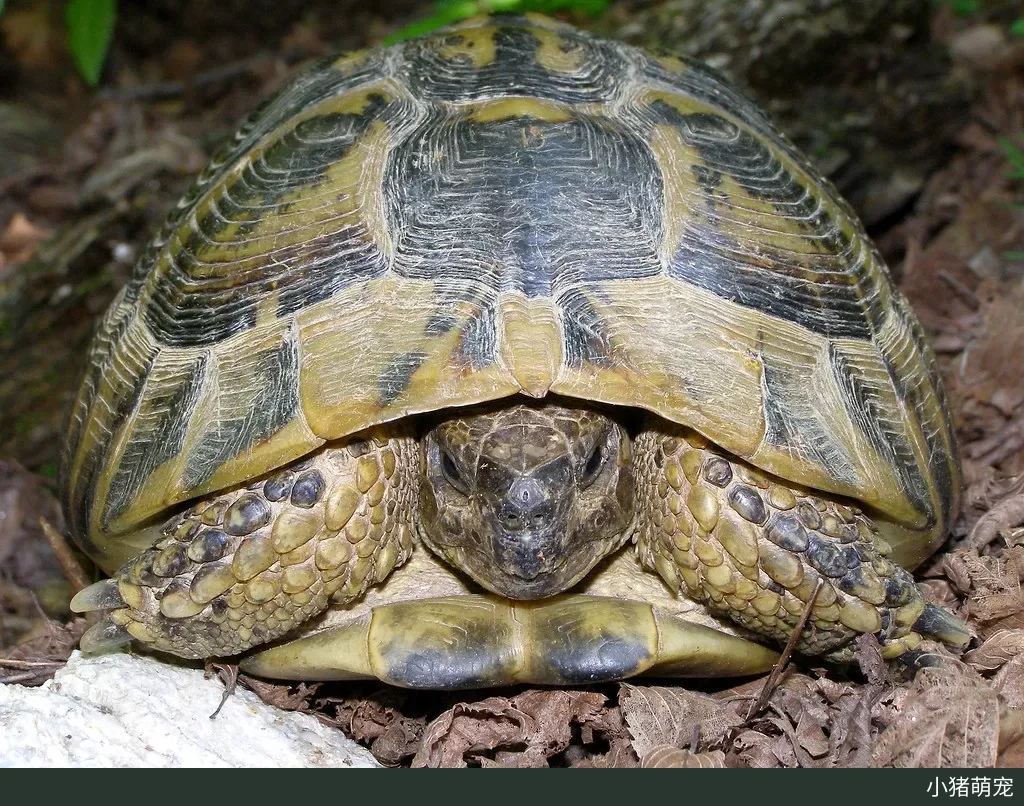
A Hermann's tortoise on dry leaf litter (uploader labeled western subspecies Testudo hermanni hermanni; location not stated), head and forelimbs partly tucked at the shell edge. Photo: Mircea Nita (anabis); source: Flickr; license: CC BY 2.0.
Housing and diet
Veterinary sources generally recommend as much space as possible: in warm seasons, a securely enclosed outdoor grassy area with good drainage is preferred; indoor enclosures must also be large enough for free movement. Daytime ambient temperatures of about 15–30°C, with a basking spot of 32–35°C, are suitable; nights may drop to 5–25°C, with humidity around 40%–75%. The Royal Veterinary College (RVC) care sheet advises high-output (10%–12%) UVB lamps indoors to mimic strong Mediterranean sun, with basking lights on about 12 hours a day and off at night, and the cool end held near 20–25°C. Importantly, most glass and acrylic block UVB, so lamps must sit inside the enclosure; sunlight through a window provides almost no UVB.
Indoors or outdoors, fencing must prevent escape and predators—dogs, foxes, birds, and rodents can injure tortoises. Substrate should be at least 5 cm deep for digging, with hides provided. Do not mix tortoise species, to limit disease spread. Hibernation is natural for Hermann's but hard to manage in captivity: veterinary guidance suggests 5–10°C, with healthy adults hibernating up to about 3 months under artificial conditions; because safe hibernation is difficult to reproduce, some reptile specialists keep them gently active year-round instead. Before hibernation, a veterinary check including fecal parasite testing is advisable.
Diet-wise, wild Hermann's are more than 90% herbivorous, favoring legumes and clovers, and occasionally eating earthworms, snails, or even carrion—but veterinarians advise feeding captives as strict herbivores. RVC recommends wild greens for more than 70% of the daily diet—e.g. sow thistle, dandelion, plantain, chickweed, sorrel, and bindweed; sedum, hibiscus flowers, and nasturtium are also fine. Plants must be free of pesticides and fertilizers; use vegetable salad only when wild greens are short. Fruit is high in sugar: RVC advises avoiding it; a Vet Times veterinary article allows at most 5% of the diet, and no animal protein. Lettuce-, cucumber-, and tomato-heavy “salad meals” are popular with tortoises, but Tortoise Trust likens them to human junk food: satisfying short-term, harmful long-term.
Calcium is the “building material” for shell and bone. RVC advises alternating calcium powder and a multivitamin–mineral supplement on food; LafeberVet suggests a captive diet calcium-to-phosphorus ratio near 2:1. Fresh water should always be available, ideally in a shallow dish deep enough for the tortoise to soak in, changed daily; RVC also suggests twice-weekly soaks in shallow warm water to aid hydration and elimination.
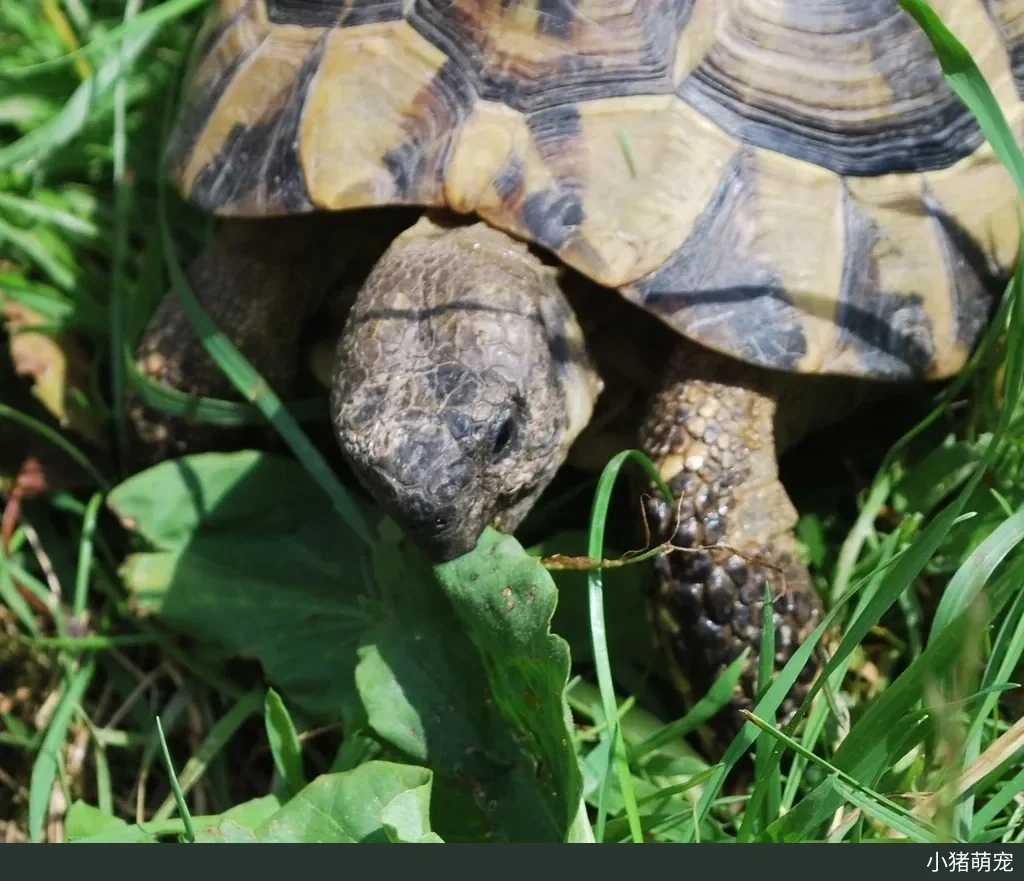
A Hermann's tortoise grazing on green leaves in grass (source caption: “Hermann's tortoise eating grass”). Source: rawpixel; license: CC0 1.0.
Common health problems
Veterinarians note that most tortoise disease is linked to—or directly caused by—poor husbandry. The classic example is metabolic bone disease (MBD): with insufficient calcium, imbalanced calcium–phosphorus ratios, or inadequate UVB, the shell softens, deforms, or develops “pyramiding,” sometimes with slow growth, weak limbs, or spontaneous fractures. Juvenile skeletons develop fast; Tortoise Trust warns that only weeks of wrong diet can cause irreversible damage—slow, even growth is better for long-term health.
On infectious disease, Hermann's tortoise herpesvirus is often reported in Europe; the species is especially susceptible to TeHV3, and disease is often severe. Other problems include upper respiratory infection, pneumonia, stomatitis, aural abscesses, and diarrhea commonly linked to ascarids. Nasal discharge, wheezing, reduced appetite, and conjunctivitis are common “runny nose syndrome” signs; pathogens may include mycoplasma or herpesvirus, often brought in with unquarantined new animals—so NACVet advises at least three months' isolation for newcomers. There are also reports that vitamin A deficiency retinal damage can leave Hermann's blind after hibernation, and post-hibernation anorexia is a common reason for veterinary visits. If anything looks wrong, contact a veterinarian experienced with reptiles promptly.
Protection status, domestic rules, and ethics
Internationally, Hermann's tortoise is listed with Testudinidae spp. on CITES Appendix II. In the EU it is on Annex A of the wildlife trade regulation and protected under Habitats Directive Annexes II and IV and Bern Convention Appendix II. The IUCN Red List's 1996 global assessment was Least Concern / Near Threatened; the IUCN Tortoise and Freshwater Turtle Specialist Group's 2011 species account already noted that assessment needed updating. IUCN released a new assessment in May 2024—use the Red List website for the current category. Regionally, Italy's 2013 national Red List ranked it Endangered (EN) because habitat degradation, fire, and agricultural intensification were suspected to have cut local populations by more than half over about three generations (30–40 years). The turtle specialist group also notes most western populations are clearly declining, driven mainly by habitat loss, collection for the pet trade, and rising local predator numbers.
In China, Article 37 of the Wildlife Protection Law provides that wildlife listed on international conventions China has joined that ban or restrict trade, once approved by the State Council wildlife-protection authority, is managed under that law. A case publicized by the Supreme People's Procuratorate in April 2024 stated that Hermann's tortoise (赫尔曼陆龟 / 赫曼陆龟) had been duly approved as a national Category II protected wild animal; a party who sold one was ordered to forfeit the animal and 1,300 yuan in illegal proceeds, plus a fine of twice the animal's value.
Legal private keeping is still in a pilot stage, and local practice is not uniform. Zhengzhou Forestry Bureau replied in August 2024 that the National Forestry and Grassland Administration decided in January 2024 to continue a terrestrial wildlife special-marking pilot in Henan, with Hermann's among seven pilot reptiles; captive-bred individuals with the prescribed mark may be transported and kept with that mark, while breeding or commercial activity still needs administrative permits. Fujian Forestry Bureau replied in April 2026 that Hermann's special-mark management is only piloted in Henan, and keeping in Fujian requires a captive-breeding license. Guangdong Forestry Bureau's September 2025 reply said tortoises of legal captive-bred origin, lawfully allowed for sale, and fitted with special marks and microchips may be kept as pets, but must not be used to expand breeding stock or for trade. Before you commit, check with your local forestry authority and keep proof of legal origin.
Finally, think ahead: NACVet's lifespan reference for Hermann's is 70–100 years—keeping one is often a multi-decade commitment, including who will take over later. Wild populations already face pet-trade collection pressure; do not buy animals of unclear origin. If you cannot keep one, do not release it—Italy's assessment lists hybridization with introduced Balkan subspecies among threats to local populations.
References
-
CITES Secretariat. Testudo hermanni | CITES
-
Bertolero A, Cheylan M, Hailey A, Livoreil B, Willemsen RE. 2011. Testudo hermanni – Hermann's Tortoise. IUCN/SSC Tortoise and Freshwater Turtle Specialist Group, Chelonian Research Monographs No. 5.
-
Luiselli L. 2024-05-05. Testudo hermanni. The IUCN Red List of Threatened Species.
-
Comitato Italiano IUCN. 2013. Testudo hermanni – Lista Rossa dei vertebrati italiani.
-
Pollock C. 2015-03-18. Basic Information Sheet: Hermann's Tortoise. LafeberVet.
-
LafeberVet. Basic Information Sheet: Mediterranean Tortoises.
-
Royal Veterinary College, Beaumont Sainsbury Animal Hospital. 2022-12. Mediterranean Tortoise Care.
-
NACVet. Hermann's tortoise — advice sheet.
-
Vet Times. Caring for Mediterranean tortoises.
-
Tortoise Trust. Taking care of pet tortoises.
-
Wildlife Protection Law of the People's Republic of China, Ministry of Ecology and Environment website, 2023-02-20.
-
Supreme People's Procuratorate. 2024-04-03. Making fairness and justice tangible · Procuratorial work for people's livelihood | Bridging administrative and criminal enforcement to protect the environment.
-
Zhengzhou Forestry Bureau. 2024-08-20. Reply on the 2024 green iguana Henan pilot opening (mailbox reply).
-
Fujian Forestry Bureau. 2026-04-15. What procedures are needed to keep a marked Hermann's tortoise bought from Henan in Fujian?
-
Guangdong Forestry Bureau. 2025-09-08. On keeping sulcata tortoises (interactive reply).